Empathy and sensitivity are essential skills for anyone working with older adults. Research shows that understanding the personal experiences of patients not only improves communication, but positively affects patient-care outcomes.
Allen College Assistant Professor Steven Bowen, OTD, OTR/L, CAPS, experienced this firsthand during his years as an occupational therapist. He worked primarily with the geriatric population in skilled nursing homes and long-term care facilities. As a result, he knew a more empathetic perspective improved the quality of care. That’s why he decided to study the effect of geriatric simulation scenarios on his graduate occupational therapy students.
“When you’re asking an elderly person with arthritis to open a jar, you need to think a little bit differently,” said Bowen, who has been teaching for five years. “It’s good for students to get a realistic perspective before they go into practice so they can better understand what they’ll be dealing with.”
Bowen used Realityworks’ Geriatric Simulator and Geriatric Sensory Impairment Kit to identify how the use of age simulation gear during daily activities changed students’ empathy toward aging adults. Here is what he learned.
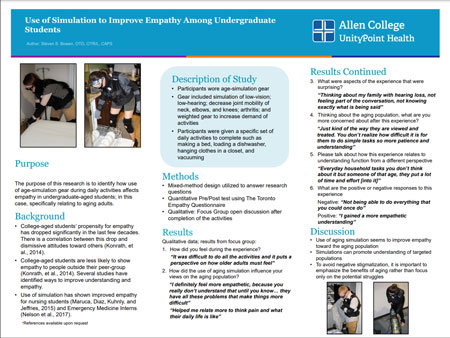
Learn more by downloading Bowen’s complete research poster, which details his methods, student feedback and results.
Aging simulation seems to improve empathy toward the aging population
Bowen’s students wore Realityworks’ Geriatric Simulator while completing daily tasks like getting dressed and cleaning. They also used the Hearing Impairment Simulator, Geriatric Arthritis Simulator and Geriatric Tremor Simulator that come in the Geriatric Sensory Impairment Kit. Afterward, Bowen surveyed them for feedback.
Qualitative feedback from the focus group included statements like:
- “It was difficult to do all the activities and it puts a perspective on how older adults must feel.”
- “I definitely feel more empathetic, because you don’t really understand that until you know… they have all these problems that make things more difficult.”
- “[The simulators] helped me relate more to what their daily life is like.”

Geriatric simulations can promote understanding of targeted populations
According to Bowen, incorporating geriatric simulation scenarios into today’s classrooms is beneficial “for a lot of different populations.”
“Simulation has shown to be effective – that’s the takeaway,” he said. “Helping students practice those kind of things before they get into the real world is definitely going to be an advantage.”
Geriatrics simulation exercises can help students understand both potential struggles and benefits of aging
One aspect of the study that surprised him was the amount of students who expressed that they did not want to age. They reminded Bowen how important it is to emphasize the benefits of aging along with the potential struggles.
We emphasize the benefits of aging in Lesson 8 of our Geriatric Experience curriculum, which accompanies our Geriatric Simulator. Titled “Amazing Aging,” this lesson addresses the achievements of some amazing older adults. It also identifies tips for leading a longer, healthier life.
We’ve made our curriculum available to everyone to assist teachers during the pandemic. Click here to sample the curriculum in its entirety, even if you do not own our simulator.

With increased sensitivity comes improved care
“To get the person you’re treating to the best functional point in their lives, you have to understand what their limitations are,” said Bowen. “A simulation doesn’t give you the true picture, but it’s closer. Being able to think dynamically, from different perspectives, allows the therapist to, through interventions and strategies, understand their patients at a deeper level than they would otherwise be able to.”
Learn more
- Learn more about Steven Bowen’s study by downloading his research poster, “Use of Simulation to Improve Empathy Among Undergraduate Students”
- Get ideas for using our Geriatric Simulator in your classroom by reading this recent blog, “3 Ways to Use a Geriatric Simulator In Your Classroom”
- Download our free guide, “Classroom Ideas to Help Students Develop Empathy Toward Older Adults”