 The Child Care Experience Curriculum is designed to bring fresh energy to childcare education, helping students develop the skills and knowledge needed for careers in early childhood education. Preparing students for careers in this field requires more than just theory—it takes hands-on experience and engaging lessons that bring key concepts to life.
In our recent webinar, Using the Child Care Experience Curriculum to Bring New Energy to Your Childcare Pathway, we explored how this resource can enhance hands-on learning, reinforce key childcare concepts, and better prepare students for real-world caregiving roles. In this blog, we’ll recap the key takeaways from the webinar and highlight how the Child Care Experience Curriculum can support training for this field.
Child Care Experience™ Program
The Child Care Experience™ Program is a comprehensive educational tool designed to provide students with realistic, hands-on training in early childhood education and childcare practices. This program integrates simulation hardware, interactive software, and a robust curriculum to create immersive learning experiences that prepare students for real-world caregiving roles.
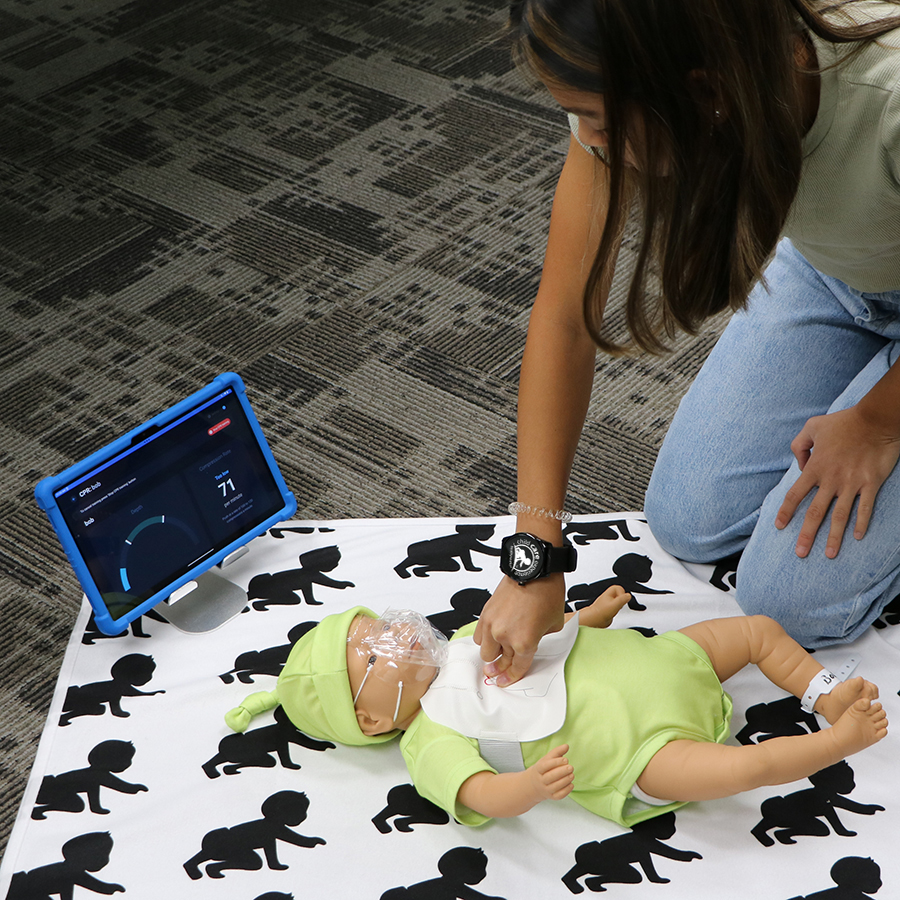
The program features lifelike infant simulators at two different ages to simulate what it’s like to work with multiple infants at varying developmental stages simultaneously. These simulators allow students to practice essential caregiving skills, including feeding, diapering, and recognizing safety hazards to enhance their practical understanding of infant care.
Specialized software tracks and assesses student interactions with the simulators. This feature provides reports on student performance, enabling learners to reflect on their caregiving techniques and identify areas for improvement. The software’s data-driven insights support personalized learning and skill development.
Child Care Experience Curriculum
The Child Care Experience Program includes a curriculum that covers topics like infant feeding, PIES, and lesson planning. It aligns to the National FCS Standards and contains eight lessons that are broken into Focus, Learn, and Review sections. The Focus section captures students’ attention, the Learn section teaches the main objectives, and the Review section reviews key points and assesses knowledge.
Lesson 1: Infant Feeding and Nutrition
This lesson of the Child Care Experience Curriculum begins with a pre-assessment that leads into a slide presentation and hands-on practice feeding the 3- and 9-Month Child Care Experience Babies. The lesson concludes with a review activity. Students will learn about the importance of good nutrition for infants, safe feeding practices, and how feeding infants is important to their physical, social, and emotional development.

Lesson 2: The Developmental Domains of Infancy (PIES)
Like the previous lesson, this one kicks off with a pre-assessment that leads into a slide presentation. Through the presentation, learners will review the physical, intellectual, emotional, and social developmental domains of infancy. In the review activity, students work through case studies.
Lesson 3: Lesson Planning and Daily Schedule Planning
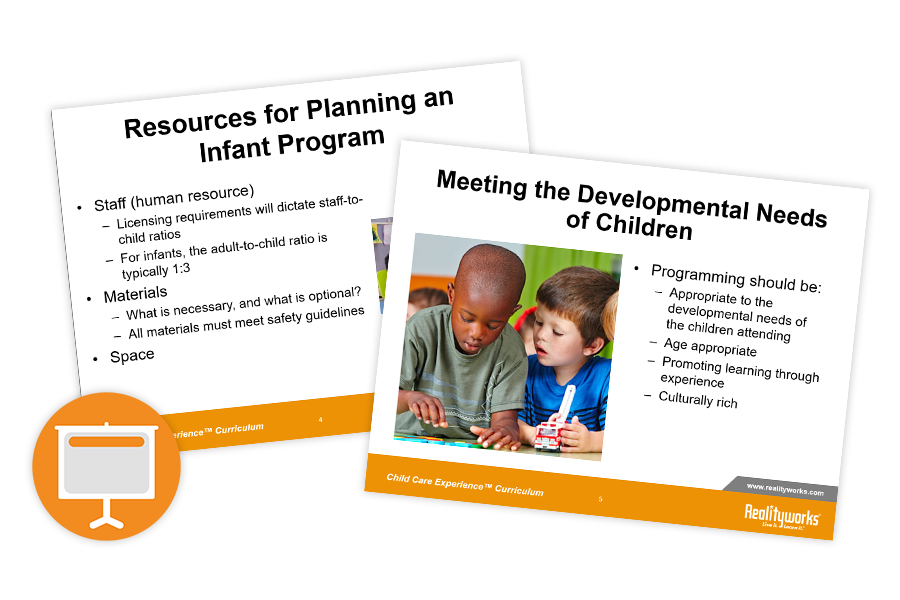
Lesson three of the Child Care Experience Curriculum starts with a brainstorming activity to get students thinking about how they would schedule a day of caring for infants. The Learn section centers around a slide presentation and reviewing sample schedules. The lesson ends with activities on childcare licensing and lesson planning for infants.
Lesson 4: Communication with Parents
This lesson begins with an activity about the seven Be’s of effective communication with parents. Students will then watch a slide presentation and review infant daily reports. During the presentation, students will learn about the importance of effective written and verbal communication between caregivers and parents of children in a childcare setting. The lesson concludes with an assessment activity.
Lesson 5: Entrepreneurship – Opening a Child Care Center
Lesson five of the Child Care Experience Curriculum kicks off with a childcare center dream sheet, encouraging students to envision their ideal childcare facility. Then, students watch a slide presentation before participating in an activity in which they create their own childcare center plan.

Lesson 6: Emergency Infant CPR
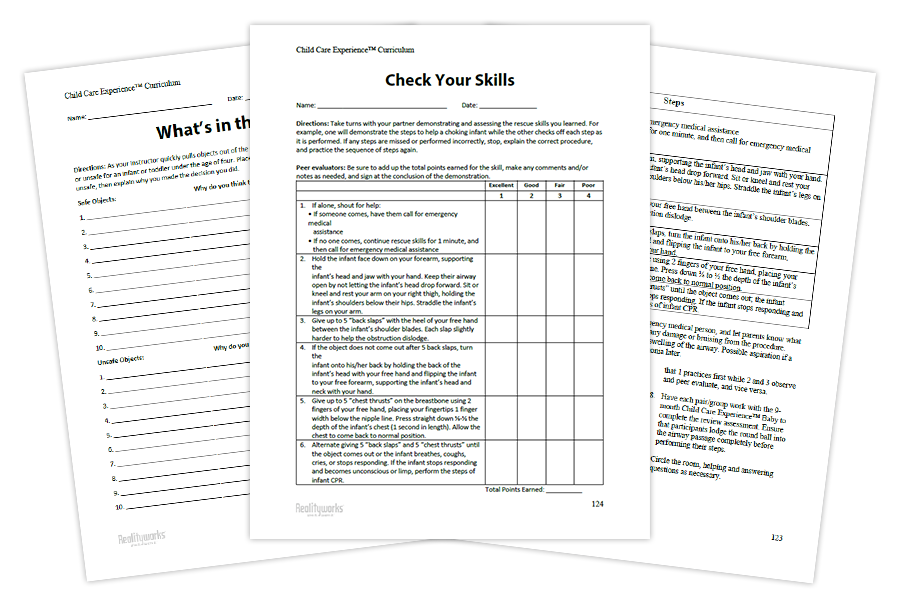
This lesson starts with a review of infant CPR steps and proceeds into a slide presentation. Students will also get hands-on practice with infant CPR. In the Review section, learners take a test to assess their knowledge.
Lesson 7: Infant Airway Obstruction
Lesson six of the Child Care Experience Curriculum begins with an activity where students identify items infants can choke on. In the Learn section, they watch a slide presentation and get hands-on practice with infant airway obstruction. The lesson concludes with a test on these procedures.
Lesson 8: Child Care Simulation Experience
The final lesson kicks off with a quiz to see if students are ready for the simulation. In the Learn section, students practice with the Child Care Experience Babies in Demo Mode and rotate through the simulation. Finally, students complete a debrief and reflection to close out the curriculum.
Sample Activity from the Lessons
As an ice breaker activity, this infant feeding and nutrition pre-test helps gauge learners’ understanding of key concepts. You can display the questions on a screen, distribute printed copies, or read each question aloud to encourage discussion.
Additional Resources
The Child Care Experience Curriculum provides hands-on training, real-world scenarios, and engaging lessons to better prepare students for childcare careers. Ready to explore more? Check out these additional resources!
- Watch the full webinar here for more activities and resources
- Explore our free career exploration lesson plans
- Check out free resources to help engage students and teach in-demand skills