Taking care of one baby for a single weekend, as students who use RealCare Baby® do, is tough. But caring for multiple babies at once — each with different schedules and needs — can be much harder to manage. How do you develop those skills if you want to enter that profession? Family and Consumer Science teacher Stephanie Boley wondered the same thing and wanted to give her students real insight into being early childhood caregivers.

“Being able to understand what it takes to care for multiple infants is so important — these kids will use their skills at family events, etc., if not in careers,” said Boley.
Stehpanie Boley | 7th-12th Grade Teacher | Mooreland School District | Oklahoma
Boley is a 7–12 grade Family and Consumer Sciences (FCS) teacher at Mooreland School District in Oklahoma and teaches a variety of classes. When she started two years ago, she received a gift from the previous teacher: Realityworks’ Child Care Experience™ (CCE) Program.
 Meet the CCE Program
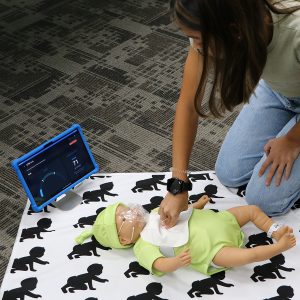
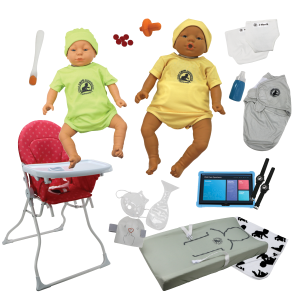
The CCE Program is an advanced, immersive childcare simulation designed to provide real‑world caregiving practice in early education and childcare settings. It features 3‑month and 9‑month Child Care Experience Babies that allow students to practice caring for infants at different developmental stages.
The program’s software tracks successful, attempted, or missed care; notes logged in the Baby Care Journal; responses to random scenarios; and which student addressed each care event. Educators can customize simulations to the difficulty level and experience desired for each individual or group, and they can receive detailed assessment reports.
Students are responsible for burping, changing diapers, rocking, responding to fussy events (using the pacifier for the 9‑month‑old Baby and soothing blanket for the 3‑month‑old Baby), feeding, and dislodging choking objects. Multiple care events can occur at random times across several infants simultaneously — reflecting the realities of a childcare classroom rather than a single‑child parenting experience.
Helping Students Become Confident Caretakers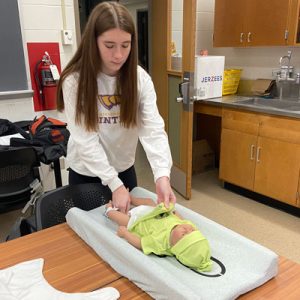
Before letting the students run the simulation, Boley discussed different infant‑care topics so the kids were well prepared.
“Before the students could do anything, we talked about the reproductive system, contraceptives and generalized health topics, fetal development, the impacts of pregnancy and genetics, the importance of prenatal and postnatal care,” said Boley. “We talked about postpartum depression and other topics.”
She also helped students understand real pregnancy experiences from their community to make the learning even more authentic.
“I reached out to parents in the community who were comfortable sharing their pregnancy stories, which I shared with my students to help them understand that pregnancy affects everyone differently,” says Boley. “I also made my students write their own birth plans, so they understood all the choices someone might have.”
Opening Up a “Daycare“
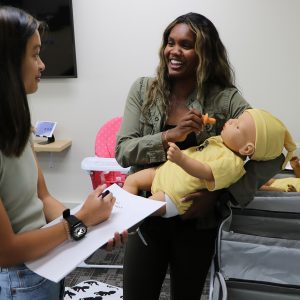
Once the students finalized their birth plans, Boley introduced the CCE babies. She had them work with the simulators while talking through the experience and what it looks like to provide proper care.
“I had them take care of the 3‑month‑old and the 9‑month‑old, and we talked about milestones, what happens at all of those age ranges and above, all the way up to when they are a tween,” said Boley. “We talked about career clusters related to childcare — many of my kids know they want a career in childcare, so we talked extensively about what it takes to care for kids, the certifications and education, and whether they want to work in a daycare, etc.”
Boley also brought in professionals from related fields to talk to the students about their unique roles within childcare.
“I had pediatric nurses come in, doulas come in, all to help my students understand various related careers. This was a lengthy two‑month unit that spanned fetal development to toddlers and beyond.”
As part of the simulation, the babies required many different care events like burping, feeding, and diaper changes. They also had emergency care events, such as choking and CPR, that Boley had her students respond to.
“I took this part of the simulation incredibly seriously — I told the students they must take care of these babies like they are real. We talked about SBS [Shaken Baby Syndrome], etc.,” states Boley. “That was a really heavy week because I talked to them about what happens if you neglect your baby in some way, what your baby might eventually look like if you make certain choices, etc. I took it pretty seriously and didn’t leave any rock unturned.”
Lessons That Last
After their simulated daycare experience, students were able to bring the lessons they learned into other areas of their lives.
“What was so validating was last year, I had two students whose older siblings were pregnant. Everything they learned in class, they went home and talked to their older sisters about, and they were actually able to help their siblings out,” says Boley. “Being able to turn around and feel more comfortable with a real baby was such a gift. The response has been really, really positive.”
Learning tools used:
Child Care Experience™ Program
Child Care Experience™ Program (CCE) is an immersive childcare simulation that builds real-world caregiving skills for early childhood education careers.
View Details