Earlier this year we hosted a free webinar on delivering content from our RealCare Baby® curriculum in an e-learning environment. Hosted by longtime Realityworks product manager Denise Bodart, the webinar shared 3 RealCare Baby lessons you can facilitate online.
With many schools returning to blended or entirely virtual learning environments this fall, we know teachers are working hard to provide engaging content online. Use these ideas in combination with Zoom, LMS systems and other technologies to teach important lessons from our RealCare Baby curriculum in an e-learning environment.
You can access ALL of our RealCare Baby curricula for free here.
Lesson #1: Holding and Feeding (from RealCare Baby’s Basic Infant Care curriculum, which focuses on child care career skills)
Part 1: Holding and Handling an Infant
Before your virtual lesson, pose this question to students via email or an LMS system: When and why would a caregiver need to hold or handle an infant? As you collect questions from students, prepare a master list so you can ensure that questions will be addressed in the lesson at some time.
Begin your virtual lesson by explaining how infants are totally dependent on their caregivers to move and be comfortable. Remind them that the infant’s only way to communicate hunger or any other needs is to cry.
Then, demonstrate via your own video (using Baby if you have it) how to properly pick up an infant who is lying on his or her back. As you demonstrate, explain the steps you’re taking and why you’re following them.
Next, use your video to demonstrate three ways to hold an infant: cradle hold, shoulder hold, and football hold. As you demonstrate, explain the importance of supporting the head, neck and back.
Conclude by asking students why it is so important to support an infant’s head and neck. You could send that out as a quick discussion thread or send an via email.
Don’t have Baby at home? Share our RealCare Baby Participant Care video or have your students download the free RealCare Baby Guide App and watch video clips of various care events.
Part 2: Feeding and Burping an Infant
Before your virtual lesson, give your students (via email or an LMS system) a copy of the Bottle Preparation and Bottle Feeding handout.
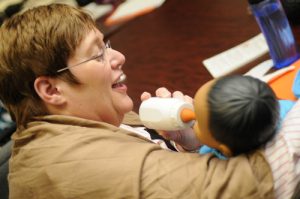
Begin your virtual lesson by sharing content and discussing the steps for preparing a bottle.
Share Slide 6 from the curriculum and demonstrate how to properly feed an infant, (using Baby if you are able to) or verbally explain the proper feeding steps (as outlined in the Slide). Then, use Slide 7 and demonstrate or explain the three methods of burping an infant.
Finally, share Slide 10, emphasizing the importance of responding to an infant’s hunger cries as soon as possible, trying to detect an infant’s different cries.
Other content we recommend sharing for this lesson:
- Slide 11 to address Baby Bottle Tooth Decay
- The Breastfeeding Facts and Formula Feeding Facts handouts as you discuss ways to feed an infant. The accompanying worksheet could be a live activity or homework.
- Slides 12-13 to continue discussion on breastfeeding versus formula feeding
Conclude the lesson and reinforce what your students have learned with the Holding and Feeding Basics worksheet, which could be shared via email or posted in LMS system.
Lesson #2: Parenting Styles (from RealCare Baby’s Parenting curriculum, which focuses on parenting)
Before your virtual lesson, share the Parenting Styles Self-Quiz via email or an LMS system to give students a chance to think critically about their own parenting styles and biases, if any.
Begin your virtual lesson by sharing (via your screen or by emailing or posting beforehand) Slides 15-17 from the curriculum so students can see what parenting style they gravitate towards.
You can also kick this lesson off with a video! We recommend the following:
- Quiz on Parenting Styles (12:23)
- TED Talk on Parenting Styles (11:58)
- 4 Types of Parenting Styles (13:40)
Now, it’s time to discuss parenting styles. You can share Nurturing Parent Skills worksheet via email or LMS system, instruct students to draw their own square and quadrants, or have student weigh in live.
Conclude by sharing the Natural vs. Logical Consequences worksheet. Students can write down their answers and submit them or submit their own recorded video clips of natural and logical consequences.

Lesson #3: Cost of a Baby (from RealCare Baby’s Healthy Choices curriculum, which focuses on pregnancy prevention and sex education and wellness)
Before your virtual lesson, ask students to submit to you how much they think it costs to have a baby the first year (and let them know you’ll share their answers with them after the lesson for comparison).
Begin your virtual lesson by giving each student the Baby Costs Worksheet from the curriculum. Instruct them to conduct research to answer each question as accurately as possible, provide a deadline, points for supporting materials, etc. – whatever you prefer.
Conclude by sharing a chart that compares each student’s cost guesses before and after the research project.
Want to add some fun? Consider these ideas:
- Create a “Price is Right” game using a free PowerPoint template like this one
- Play the “high/low” game virtually by choosing 20 baby items and having students guess via chat or live in a Zoom like environment
Finally, encourage reflection on this activity by posing the below questions, either live during your virtual lesson or as a writing assignment:
- What kind of financial and time management choices do responsible, mature parents make?
- How do our society and culture influence how people parent?
- How can parents save money when purchasing infant items?
- Do you think your parents made sacrifices when you were a young infant/today? Explain.
Access the handouts we referenced in this blog, plus other tips and tricks
- Watch the entire 45-minute webinar (and and get more details on RealCare Baby lessons you can facilitate online) here
- Access all of your RealCare Baby guides and curricula