 EMS instructors have a big responsibility. The skills they teach will not only help students succeed in careers, but save lives. The more engaged their students are in class, the more information they’ll retain – information that could change the outcome of an emergency situation.
We recently hosted a free webinar about effective teaching strategies for EMS instructors. Hosted in part by both Denise Bodart, longtime Realityworks product manager, and Krista Wenz, MICP, the webinar reviewed strategies and practices Krista has relied on for over three decades to help her keep students engaged and ensure they learned key skills. Here are Krista’s 5 go-to teaching tips.
Tip #1: Know your students
To be an effective instructor, you need to know your students. Use a self-evaluation form at the start of each course to determine a few key facts:
- What type of learner are you? (Should you use more flashcards and textbooks, or more videos?)
- Why are you taking this course? (Why are they here – do they want to work as an EMT or firefighter, or do they want to go to medical school?)
- Do you have any learning challenges or struggles? (If you’re aware of the struggle, you can tailor lessons accordingly)
In addition, consider asking these questions on the first day of class – and encourage them to answer in front of their peers so you can gauge how comfortable they are speaking in front of others. “What’s your name?” “Why are you taking this course?” “Tell us something funny.” Or, they can share an experience they’ve had with first responders.
In addition to knowing your students, it’s good to know what students want in a teacher. Research shows that students across the US want their teachers to be able to build trusting relationships with them. They want their teachers to be able to create safe, positive, and productive learning environments.
Tip #2: Know your stuff
From Krista: “Most EMS instructors I know, myself included, had zero teaching experience prior to becoming a teacher… but I knew I was passionate about the subject. I learned how to be a good instructor by emulating the instructors who inspired me. If you have a passion for what you’re teaching, students will see that and respond to it.”
According to Krista, the most important way that a person can be a good and effective EMS provider is if they understand the pathophysiology behind a patient’s symptoms. An effective instructor will help the students understand why a person’s blood pressure drops and their pulse is elevated in hypovolemic shock. It’s not only memorizing the subject matter; it’s understanding why the human body is doing what it is doing when under stress. If students understand the pathophysiology, they will be able to treat even the most difficult of patients.
If a student asks a question and you don’t know the answer, be honest. Tell them that’s a great question and you will get back to them with the answer after break or at the next class. Besides just having the expertise in the field of emergency medicine, an effective instructor must be able to interact with students and help them understand a new way of looking at the world.
Although there are many different ways to teach effectively, good instructors have several qualities in common. They are prepared, set clear and fair expectations, have a positive attitude, are patient with students, and assess their teaching on a regular basis. They are able to adjust their teaching strategies to fit both the students and the material, recognizing that different students learn in different ways. As a teacher, you are a role model who sets the tone for class. If you are able to show enthusiasm and commitment, your students are more likely to reciprocate.
Tip #3: Balance lecture with hands-on experience
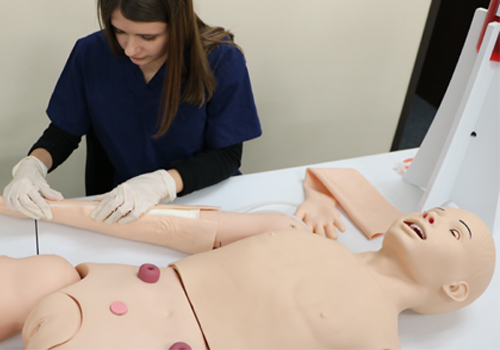
While there are many hours of lecture in any EMT course, breaking it up with hands-on experience will keep the attention of your students. Krista recommends lecturing for 15-30 minutes, then breaking into small groups for hands-on skills practice.
Another way to keep your students engaged is by telling brief “war stories” that pertain to what you are teaching. Try to pick something very unusual, like a once-in-a-lifetime call you were on – something that will make the students think outside of the box, and something you would never read about in a textbook.
Think of your students as teammates, not adversaries. Learning and teaching are challenging, but that doesn’t mean that you can’t have fun in the classroom. Stay focused, but don’t be afraid to be creative and innovative. Allow yourself to be enthusiastic and find ways to let students see what is interesting about your subject.
Tip #4: Use guest speakers
Guest speakers who are first responders are an important part of the educational experience for students. They expose students to real-world life experiences from the position of someone who has been there. Plus, they offer a different point of view to your students
Guest speaker experiences can also come in the form of ride-alongs, which are a great way give students an idea of what first responders do. Ride-alongs also let students see if this is a career they can stomach, especially when arranged in the beginning of a program.
Tip #5: Seek outside resources
There are many sources of additional information available, and many change every week. Social media, online applications, videos, blogs… don’t be afraid to continue researching and looking for new, interesting ways to present old information.
You can watch the entire webinar and access free activities for EMS students here.
Learn more
Find more resources on teaching important healthcare topics below:
On-demand webinars:
- The Art of Scenarios: Using Real World Scenarios to Teach Nursing and Soft Skills:
-
- Developing Geriatric Sensitivity in Your Generation Z Students
- 10 FREE Resources for Teaching Health Science Concepts Online
Access the curriculum and activities that accompany our health science learning aids here.
Free guides: Implementing Geriatric and CNA Training Tools into your program
Watch a brief walk-through of our award-winning health science products here.