Earlier this summer, we presented a free webinar on how to implement a 21st Century welding program. During the webinar, Realityworks product manager Jamey McIntosh profiled a high school in Marana, Arizona that had more than tripled enrollment in welding classes following a major expansion of its program. Attendees heard from Marana High School (MHS) Welding Instructor Kenton Webb, a former ironworker who has spearheaded the expansion of his school’s welding program since he began teaching 12 years ago.
Here’s what he told us worked – and what he’s continuing to do to ensure his program’s success.
A 21st Century welding program: 3 phases to success
To create a successful 21st Century welding program, we’ve found that using a 3-phase welding training process is key. In this process, students start by using virtual reality to learn basic skills. Virtual reality also creates a safe, spark-free environment in which to introduce novice welders and get students thinking about careers.
Once students have mastered basic skills through virtual reality, they can transition to welding in a live booth with guidance. This helps them continue honing fundamental skills while getting used to welding with sparks. Of course, when students are ready to conduct live welds without guidance, they can do so with the proper techniques and correct muscle memory these tools have helped them develop.
Finally, we recommend that your 21st Century welding program include training tools that address weld defect causes and prevention, and that allow students to conduct bend tests.

Start by creating a foundation for all student learning
Kenton started by incorporating Realityworks’ guideWELD® VR welding simulators into his program and saw immediate results. Not only were more students interested in learning welding skills – after all, practice was “like playing a video game” – but they appeared more comfortable learning new skills.
“Welding is an attractive thing for kids – they get to play with fire and melt things,” Kenton said. “Virtual reality really helps with student buy-in… to them, it’s like playing a video game, and they really enjoy that.”
In addition to getting students interested in welding, virtual reality training tools create confidence. Students who may have balked at the sparks and equipment in a welding shop can see what it’s like to weld in a safe, spark-free environment. They can focus on practicing skills without fear… and in turn, develop the correct muscle memory and techniques needed for the correct work angle, travel angle, speed, nozzle-to-plate distance and straightness.
“It’s ultimately teaching them muscle memory and helping them understand the different angles, the distances involved in creating a good weld,” Kenton told us. “When they come to me, they’re definitely a lot more comfortable using the machines; they have a better understanding of how the basics work.”

Build on that foundation with guided, individualized learning opportunities
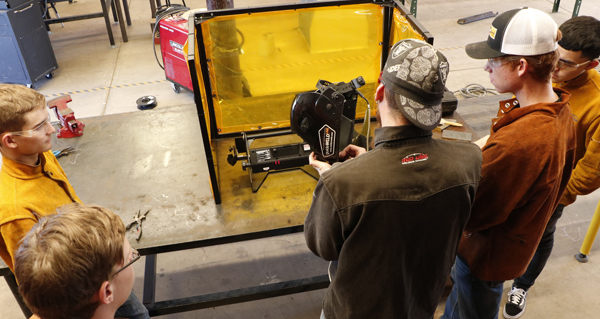
At MHS, students who have completed the required assignments using virtual reality welding simulators are able to transition to the shop floor – with additional help from Realityworks’ guideWELD® LIVE real welding guidance system.
“With guideWELD LIVE, students can feel what it’s like to weld live, but they still have assistance,” said Kenton. “We still see nervousness but having the guides and assistance right there in the hood as they’re welding helps set the students at ease.”
Because the symbols inside the guideWELD LIVE helmet are the same symbols students see on the guideWELD VR screens, students are already used to self-correcting using this personalized feedback. These individualized learning opportunities benefit novice and experienced welders alike, as feedback is specific to each individual welder. Students who need assistance with both travel angle and speed can focus on those techniques, while students who are only struggling with straightness can focus on that technique.
A 21st Century welding program
We asked Kenton how his program has changed since implementing 21st Century welding training tools. He told us that when he first began teaching welding at Marana High School, he saw 60-70 students taking welding through all three levels. This year, the school is preparing for over 400 students to participate in welding classes.
“It takes time to build a program and get kids’ buy-in. It’s not something that happens overnight,” said Kenton. “Be patient and realize that your goal is to get these kids the welding experience they need in order to be successful and get a good job once they leave high school… consider tools that will get their attention and that they’ll enjoy using. Do your research and find out what works best for you and your program and the kids that you serve in your area.”
Learn more
Ready to create your own 21st Century welding program? Use these resources to:
-
- Watch our complete conversation with Kenton:
- Download our case study, “Case Study: Welding Education in the 21st Century“
- Access our Welding Solutions Implementation Guide
- Contact us! We’ll connect you with your local account manager to discuss your unique program needs. Call 1-800-830-1416, email information@realityworks.com or take advantage of our live chat feature