Editor’s note: This article was originally published in the April 2020 issue of the Association for Career & Technical Education‘s Techniques magazine. ACTE members, log in here to see the original article.
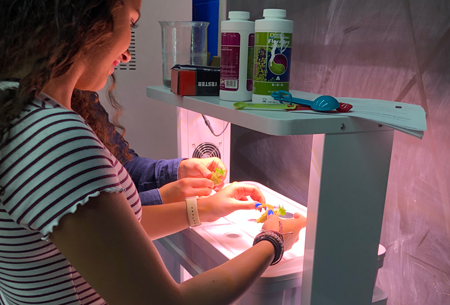
In Brent Nelson’s agriculture classroom, ninth through 12th-grade students are using water to learn valuable skills — skills they can use in future careers and in life. How? Nelson’s students are experimenting with hydroponics systems to grow plants in water instead of soil. Doing so not only enables them to grow healthy food without leaving their classroom but also prepares them for high-demand, high-wage careers (including some that don’t even exist yet).
“It’s a cliché, but I hear it all the time — the careers we’re teaching our kids about are jobs that don’t even exist yet — but they will. And those jobs will tie directly with technology,” said Nelson, agriculture teacher and FFA advisor at Franklin Junior Senior High School in Franklin, Illinois. “Hydroponics is cutting-edge technology that we can expose kids to, especially kids in smaller communities like ours, fairly easily … and we can use it to get them interested in careers they may never have considered before.”
Since Nelson incorporated Realityworks’ Hydroponics Educational Systems into his curriculum last year, he’s used the system to demonstrate plant-science concepts, compare conventional versus modern farming, demonstrate the importance of producing more with less, and market and sell produce to support his school’s FFA chapter.
Students have been so interested in using the system to grow greens that Nelson has collaborated regularly with his school’s food-service employees to serve harvested lettuce in school lunches,an endeavor he says is simultaneously helping his students learn job responsibility, recognize the need for sustainable food-production methods and start to explore careers.
“They’re not simply helping harvest lettuce; they’re spending time regularly checking the pH, checking the water … they’re involved in all the small steps it takes to get to that final product,” said Nelson. “And it’s not only teaching them job responsibility, but giving them the chance to get their hands on technology that’s new, show them how it works and get them to start thinking about the technology and careers that will be available to them in the future.”
Rehydrating Agricultural Economics
Recent research paints a bright future for students interested in careers related to hydroponics and other water-driven indoor farming methods. Considered the future of farming by many (Miller, 2018), hydroponics is a method of growing plants in water instead of soil, with a carefully formulated nutrient solution circulated to plant roots. Hydroponics is particularly ideal for high-value crops, such as herbs, microgreens and fresh vegetables; it uses water up to 90 percent more efficiently than soil and produces crops at least twice as fast (Green Our Planet, n.d.).
Furthermore, hydroponics systems can exist indoors, where growers can control temperature, lighting and other components to improve plant production. Advocates believe that hydroponics has the potential to relocate food production to urban and suburban areas, where more and more citizens are migrating (Holt, 2016). In fact, the United Nations projects that by 2030, 53 urban areas in the United States will have populations of at least 1 million, an increase from 41 cities in 2010 (Cox, 2014). All those individuals will have to work — and eat.
Demand for food is growing rapidly as well, thanks to increasing populations around the world. National Geographic predicts there will be 2 billion more people to feed by 2050; they assert that if demand for meat, eggs and dairy does not change, the “double whammy” of population growth and diet requirements will necessitate the growth of twice as many crops as are grown today (Foley, n.d.).
To grow food (and economies) in and around cities, water-driven indoor farming methods like hydroponics are expanding rapidly, creating a favorable job outlook for students interested in what’s becoming an emerging industry of high-tech greenhouses, vertical farms, hydroponics and aquaponics. A 2016 Civil Eats article cites two indoor farming start-ups, each of which opened the doors to new operations in recent years. According to the article, BrightFarms Inc. opened its second and third hydroponics greenhouses in Chicago and District of Columbia in 2016; the company aims to build 20 more commercial greenhouses in the next three to five years. Gotham Greens, which saw 400 percent growth in 2016, opened the “world’s largest” urban farm in Chicago that same year (Holt, 2016.) Even more recently, AeroFarms, a pioneer of indoor farming, had raised $100 million as of July 2019 to further expand its indoor farming warehouses (Fortado, 2019.)
Careers related to these water-driven growing methodologies are not only growing quickly; they are paying well, too. Indoor urban growers can earn annual starting salaries of up to $65,000, while master growers who have a doctorate in a related discipline can earn an annual salary of up to $90,000. That’s a 164% increase from the 2018 median salary of agriculture workers (U.S. Bureau of Labor Statistics, 2018).

“We’re seeing every day that hydroponics and aquaponics are becoming big industries, and we need to prepare today’s students for those careers,” said Nelson. “I see students coming into my classroom who don’t know what goes into growing the things that we eat, who assume it just shows up on our plates. They leave with an understanding of the work that goes into it, and a respect and an appreciation for what we have … and how that can be maintained in the future.”
Editor’s note: This article was originally published in the April 2020 issue of the Association for Career & Technical Education’s Techniques magazine. ACTE members, log in here to continue reading the complete article.