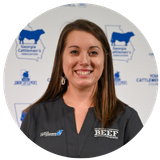
As an Agriculture and Natural Resources Extension Agent, Hailey Partain is technically a University of Georgia faculty member, but she’s rarely behind a desk. Instead, she’s “boots on the ground,” working directly in communities to teach, troubleshoot, and talk about agriculture. Unlike a traditional classroom educator, Partain works with audiences ranging from pre-K students to farmers and lifelong learners in their 90s.
Hailey Partain | Agriculture and Natural Resources Extension Agent | University of Georgia
In a county where cattle are one of the leading agricultural commodities, her work focuses on helping people understand cattle production, nutrition, and beef processing. For Partain, learning isn’t about lectures but rather experiencing agriculture in a way that feels real. By using interactive models from Realityworks, she turns complex topics into learning experiences that help audiences understand the journey from pasture to plate.
Learning Through Exploration
Despite a wide range of agricultural programs, Partain found that traditional teaching methods didn’t always make complex ideas stick.
“I’ve done PowerPoints and pictures, and they’re okay, but my students really like the hands-on side of it,” Partain explained.
Many topics she covers, from digestion to beef processing, are difficult to visualize. As a result, learners often find themselves trying to understand systems they can’t see, and some audiences are more familiar with cattle in the field than with what happens after processing.
“They’re great at the live side, but they may not know the carcass side,” she said.
Meanwhile, other learners are starting from scratch, making concepts even harder to grasp. Without a concrete way to demonstrate these processes, Partain initially struggled to create those breakthrough moments, until she discovered Realityworks’ products.
Hands-On Models, Deeper Learning
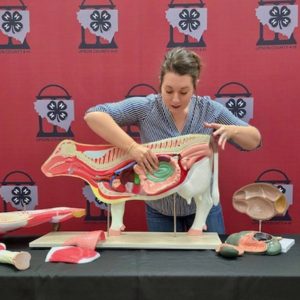
To bring these concepts to life, Partain uses interactive learning tools from Realityworks, including the Cow Model, Ruminant Model, and Butcher Beef Cut Models. Each model makes complex agricultural systems visible and hands-on.
The Cow Model allows users to explore internal systems such as digestion, circulation, and reproduction through removable organs. The Ruminant Model focuses on digestion, clearly showing the stomach’s four compartments and how feed is processed.
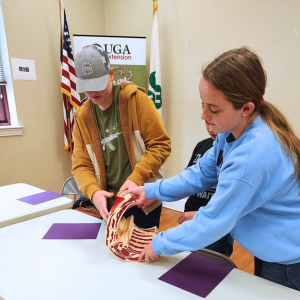
To connect the live animal to food products, the Butcher Beef Cut Models break down a carcass into primal sections and individual cuts. The magnetic, lifelike pieces can be handled and rearranged, helping learners understand where different cuts come from and how the whole animal is utilized. Together, these tools connect digestion, production, processing, and the food people recognize every day.
“They realize ground products come from everywhere. So everything is being utilized on the animal,” Partain said.
Hands-On Learning That Sticks
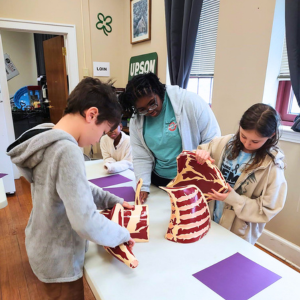
In Partain’s programs, learning is active. Whether at farm days, cattlemen’s meetings, or youth workshops, her sessions center around interaction. Using the Butcher Beef Cut Models, she often turns lessons into hands-on challenges.
“Each table had a primal, and then I took them all apart and the kids had to race to put them back together. They make the mistake of putting it somewhere else, and then they learn from it,” said Partain.
As participants reassemble the pieces, they begin to understand how cuts fit into the whole animal and connect those lessons back to the food they recognize from everyday meals.
“We talked about meals that include beef, like tacos or steak,” Partain explained. “They can relate it back to what their family just cooked the night before.”
Partain also reinforces those concepts by comparing the models to actual beef cuts, helping participants visualize the scale and structure of the animal. These opportunities for comparison help ideas stick in a way that explanation alone often cannot.
“They got to see the model and then compare the size of it in real life,” she said. “They get to physically hold them, pull them apart, and treat it like a puzzle.”
“You know when a kid is kind of looking at you like, ‘What are you talking about?’ and then suddenly it clicks,” Partain said. Creating more of those moments became the goal.
 The Impact: Greater Understanding and Engagement
After incorporating Realityworks’ hands-on models, Partain saw a clear shift in engagement and understanding. Concepts that once required extensive explanation often spoke for themselves.
“I hadn’t even used it yet. This was the first farmer to look at it. He just stopped and said, ‘I tell you, that makes sense,’” Partain recalled.
That impact carried across audiences. Learners who interacted with the models appeared more confident and demonstrated a stronger understanding of the material. Partain observed higher levels of engagement and fewer questions about concepts that had previously been difficult to explain.
For Partain, the most rewarding moments came when learners made those connections for themselves.
“It’s just a lot of those moments,” she said. “None of it’s captured. It’s just me saying, ‘Oh hey, you figured it out.’”
Learning tools used:
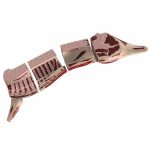
Butcher Beef Cut Model
Enhance your agriculture program with these detailed Butcher Beef Cut Models.
View Details
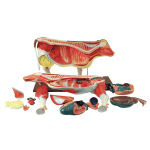
Cow Model
The Cow Model is a lifelike, one-sixth-scale model designed for agriculture educators to teach students about cow anatomy in a hands-on, interactive way.
View Detail