Research shows that nearly one in five U.S. adults live with a mental illness. Approximately 6.5 million people in the U.S. have an intellectual disability – about 3% of the population. Twice as many people as that will have PTSD at some point in their life. Considering these numbers, it’s highly likely that your health care students will need to care for someone with a mental illness, intellectual disability or who suffers from PTSD – and they’ll need adequate soft skills to do so successfully.
Our new Soft Skills Program for Caring for Patients with Intellectual Disabilities, Mental Illness, or PTSD uses interactive learning aids and real-world scenarios to introduce students to caring for these types of patients. Keep reading to learn more, hear a sample of our Dementia and Auditory Hallucination Simulators and more.
Strategies for caring for diverse patient populations
We created this program after hearing from health science instructors of the need for a classroom resource designed specifically to teach strategies for communicating and caring for these individuals. It provides real-world scenarios for students to think through and problem-solve. Additionally, it clearly defines what IDD, mental illness and PTSD are so future health care workers understand.
This interactive program includes curriculum (including lesson plans and presentation slides), scenario cards and Dementia/Auditory Hallucination Simulators. It also comes with a storage case and quick start guide.
Comprehensive curriculum provides instructor support
The curriculum that accompanies this new program is comprehensive. It includes 5 lessons, each of which integrates the program components to make learning more interactive. Each lesson takes 60-90 minute to complete in its entirety; topics addressed include defining intellectual disabilities and mental illness, as well as specific strategies for caring for individuals with IDD, mental illness and PTSD. The first two lessons include a brief pre- and post-test to see what students know and measure what they learn.
What’s more, the lecture notes that accompany each lesson detail each type of condition. They define each condition, identify signs and symptoms and more. Best practices are shared, and information on what to look for in these patients as well as the best ways to communicate are explore.
Interactive, real-world activity cards and workbooks engage learners
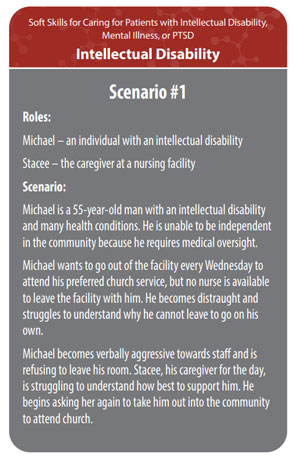
The scenario cards can be used in one-on-one groups, small groups or as large-group discussion activities. Use them to facilitate role-playing activities so students can immediately apply what they’re learning to the real world.
You’ll find scenarios that address a variety of condition within each category of scenario cards. For instance, the 10 scenario cards that address IDDs include a variety of ages and disability types, including OCD, anxiety, bipolar disorder and psychosis.
Students can use the accompanying workbooks to pre-brief and debrief, take notes and more.
Tip: Encourage your students to save these workbooks for future reference!
Realistic simulators enhance the experience

We’re excited to announce that this new program includes a set of 4 MP3 players with headphones so students can hear what it’s like to suffer from dementia (confusion) and auditory hallucinations. This simulation is key when implementing the role play part of each lesson that includes these types of conditions. By wearing the headphones and listening to the appropriate soundtrack, students’ role-play experiences will be made even more true-to-life. In turn, the students will be better equipped to develop empathy and sensitivity towards patients with these conditions.
Sample this program
Whatever health science program you teach, you’ll find our new Soft Skills Program for Caring for Patients with Intellectual Disabilities, Mental Illness, or PTSD is flexible. It integrates soft skills throughout, like communication, empathy, problem-solving and teamwork. As a result, your students will feel more confident and better prepared to work with individuals with intellectual disabilities, mental illnesses or PTSD.

It would be helpful to know what the scenarios depict.
Thank you for your inquiry, Lorie! I’m happy to inform you that we have posted a scenario card sample and a student workbook sample on our “Soft Skills Program for Caring for Patients with Intellectual Disabilities, Mental Illness or PTSD” product page here: https://www.realityworks.com/product/soft-skills-program-caring-patients-with-id-mental-illness-ptsd/. You can view the samples and other curriculum details under the “Curriculum” tab at the bottom. Of course, contact our team if you have any questions! 800-830-1416 or information@realityworks.com. Thank you!