
Gregg Schroeder, Director of Nursing Education and Health Studies at Hesston College, has spent more than 25 years working in simulation-based education. Throughout his career, he has seen how today’s learners increasingly depend on visual, hands-on experiences to understand complex healthcare concepts.
Gregg Shroeder | Director of Nursing and Health Studies | Hesston College
In his BSN program, Schroeder prepares students for careers as registered nurses, guiding them from foundational skills to advanced medical-surgical and critical care training. He uses Realityworks’ simulation tools to help students better understand one of the most challenging aspects of nursing: what’s happening inside the human body. While lectures and textbooks provide foundational knowledge, students often struggle to grasp concepts they cannot see. Realityworks’ tools help bridge that gap by allowing students to connect theory to practice and develop a deeper understanding of patient care before they enter clinical settings.
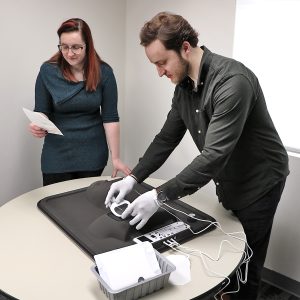
Helping Students See What They Can’t See
Schroeder saw a consistent problem in student learning: students struggled to fully grasp what they couldn’t see.
“Students today need to see it while you teach it. Visualizing what’s happening is critical to understanding,” said Schroeder.
This challenge extended beyond students.
“Even experienced ICU nurses said, ‘I’ve never really understood what was happening there before.’ That’s the power of seeing it in action,” he explained.
Traditionally, teaching has relied heavily on lectures, PowerPoint presentations, and pictures. While these methods introduced important concepts, they often fell short of clearly illustrating what was happening beneath the surface.
Bringing Concepts to Life Through Simulation
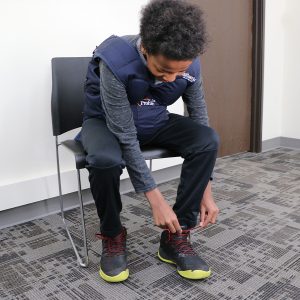
To address these challenges, Schroeder uses a range of Realityworks’ simulation tools in his lab and curriculum, including the Sterile Techniques Simulator and Pregnancy Profile 2.0 Obstetric Simulator. These tools allow students to observe cause-and-effect relationships in real time.
“By visualizing it, you finally see what’s really going on, and that’s when it clicks for both faculty and students,” said Schroeder.
The Sterile Techniques Simulator is designed for hands-on practice of sterile technique during procedures such as urinary catheterization, tracheostomy suctioning, and central line dressing changes, providing immediate feedback when sterility is broken.
The Pregnancy Profile 2.0® Obstetric Simulator is a wearable third-trimester pregnancy trainer that helps students understand the physical realities of pregnancy. Students experience changes such as increased weight, bladder pressure, and restricted breathing while reinforcing skill development through repetition and correction.
As Schroeder puts it:
“Practice doesn’t make perfect. Practice makes permanent.”
Building Confidence Through Practice
Schroeder uses the Sterile Techniques Simulator in structured, small-group simulations where students actively rotate through roles.
“One student performs, one watches, and one follows the skill sheet,” said Schroeder. “Students aren’t just watching anymore. They’re putting their hands on it, seeing it, and doing it. That’s what makes it stick.”
This structure ensures immediate feedback and accountability while building confidence in a safe learning environment. Schroeder has observed that students respond positively to the interactive, repeatable nature of simulation.
“It’s like a game. Reset and do it over again until you don’t get the ‘you broke sterile technique’ message,” he shared.
 Preparing Practice-Ready Nurses
After integrating Realityworks’ simulators into his program, Schroeder observed a noticeable increase in students’ confidence as they entered clinical environments.
“When our students go into clinicals, they’re more confident. Nurses even assume they’re seniors, but they’re juniors,” he explained.
That confidence often extends beyond the classroom. One student, after hands-on practice with the Realityworks’ Chest Tube Management Simulator, was able to better understand her mother’s medical treatment.
“Now I understand what’s going on inside her chest,” Schroeder recalled the student saying.
Program outcomes reflect that preparation.
“Ninety percent of my senior class already has jobs lined up for graduation in May,” he noted.
For Schroeder, these results reflect the value of giving students opportunities to visualize, practice, and refine complex skills before entering clinical settings. He remains committed to creating hands-on learning experiences that equip students with the skills and confidence needed to become the next generation of caregivers.
“So many students today are visual learners, and this approach really meets their needs,” said Schroeder.
Learning tools used:
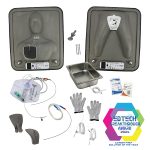
Sterile Techniques Simulator
Use the Sterile Techniques Simulator to practice sterile technique for three skills: urinary catheterization for female and male, tracheostomy suctioning, and central line dressing changes.
View Details
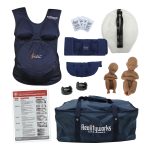
Pregnancy Profile 2.0 Obstetric Simulator
The Pregnancy Profile 2.0 Obstetric Simulator is an advanced educational tool designed to provide students with a realistic, hands-on experience of the later stages of pregnancy
View Detail

Chest Tube Management Simulator
Develop students’ confidence and competence in chest tube care with the Chest Tube Management Simulator.
View Details