 Looking for ways to liven up your classroom and get your students excited about topics like force, equilibrium and simple machines (not to mention soft skills like critical thinking and teamwork)? This RC Tractor Pull Challenge might be the perfect solution. It encourages students to learn as they play, which teens need as much as younger students. It also uses friendly classroom competition to get students excited about thinking critically and solving problems.
Realityworks Education Programs Manager (and former teacher) Jamey McIntosh recently hosted a free webinar on using our RC Tractor Pull Challenge to teach STEM, teamwork and other important skills. Here is a brief introduction to the tractor pull challenge before we dive into the 5 reasons you should use an RC Tractor Pull in your classroom.
Meet the tool: RC Tractor Pull Challenge (5-Pack) With Pulling Sled
As Minnesota agriculture teacher Nathan Anderson (@mnagteacher) recently shared on his TikTok channel, the RC Tractor Pull Challenge comes with everything you need to facilitate a tractor pull in your classroom. (Thank you, Nathan, for this stellar review!) Watch below:
@mnagteacher #greenscreen @realityworksinc
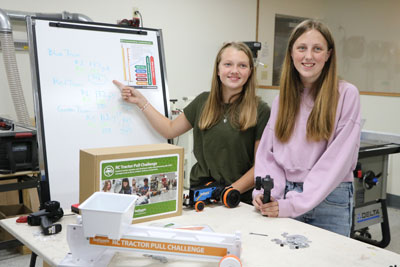
As Nathan notes, you’ll get a set of 5 tractors, RC remotes, and a variety of components to adjust on each tractor: washer weights, pinion and spur gears and tires. Larger weights are also included for the pulling sled. The curriculum includes step-by-step instructions, plus lessons and activities on gears and tires, weight and friction, and more.

5 Reasons to Use An RC Tractor Pull In Your Classroom
1: Help students understand important STEM concepts
Did you know that a tractor pull is an excellent phenomenon through which to study friction, gravity, normal force and more? We worked with a subject matter expert to ensure our RC Tractor Pull included comprehensive curriculum to help you introduce students to these important concepts.
Use the robust, 5-lesson curriculum to address:
- Scientific process
- Torque and power
- Friction
- Force
- Balance and equilibrium
- Center of gravity
- Gear ratios
- Data collection
Use these lessons to help your students understand fundamental concepts like the impact of gravity and normal force, Newton’s 3rd law. Through the lessons and activities, you’ll introduce your students to the impact weight, tires and gears have on their tractor’s performance. The curriculum includes worksheets for data collection and analysis so you can really dive into the physics of the tractor pull.
2: Get students interested in a variety of topics
Although our first reason for facilitating classroom tractor pulls is STEM, those aren’t the only concepts this learning experience addresses. Tractor pulls can be used to teach a variety of topics related to agriculture and trade skills as well. You can choose to focus your tractor pull around agriculture by honing on the agriculture mechanics side of the competition. Or, you could emphasize the design and engineering principles for a STEM course.
3: Engage students with competition-based learning
Your tractor pull challenge curriculum culminates in a friendly classroom tractor pull challenge, which can really help students enhance their understanding of lesson topics. To make the most of this competition-based learning opportunity, remember to:
- Create learning objectives for the competition
- Set competition rules
- Allow for discussion and adjustments between competitions
- Provide opportunities for analysis. An important part of STEM, analysis helps students visualize the impact of what they have learned. It creates powerful “aha” moments.
4: Practice data collection and analysis
Our RC Tractor Pull curriculum includes several opportunities for students to practice a skill that’s growing in demand: the ability to collect and analyze data. In this case, students will collect data on the impact of pinion and spur gears, hitch height, and weights. They’ll also learn how to analyze the mechanical advantage of gear combinations, tire and axle combinations, and more.
5: Create unique discussion opportunities
Each pulling challenge allows for many open-ended discussion opportunities. Although you’ll want to keep certain variables a constant, like hitch height, your students will find a variety of other concepts available to test and re-test. After the tractor pull concludes, start with the basics: What happened and why? Ask students what variables changed during each pull – were modifications made? How did they choose the modifications they made, and why did they feel one modification was better than another? Conclude by asking what they would do differently next time, and why. Every question is an opportunity for your students to develop valuable critical thinking skills.
Are you headed to the 95th National FFA Convention & Expo October 26-29? Don’t miss Nathan’s teacher demonstration for CASE Curriculum, where he’ll showcase the lessons that utilize his RC Tractor Pull Challenge. Of course, we invite you to visit Realityworks’ exhibit booth #715 anytime during the conference as well.
Resources for learning more
Looking for more information on using a tractor pull challenge in your classroom? Consider these:
- Get a thorough introduction to our new RC Tractor Pull Challenge With Pulling Sled, and review methods for implementing this training tool to address key STEM concepts, by watching Jamey’s full webinar, “Bring STEM Concepts to Life with This New Remote Control Challenge:”
- Access a free tractor pull activity in our blog, “Get Students Excited About Science With This Remote Control STEM Challenge (Plus a Free Activity)“
- Learn how Nathan is using videos to boost student engagement, and get tips for making your own videos, in this blog: “This TikTok Teacher Is Using Videos to Engage Agriculture Students – And It’s Working“