 With dental assisting career opportunities projected to increase through 2031, now is the perfect time to start or refresh a dental assisting program. These resources and tips will help you get started, ensure your content aligns to important standards and most importantly, helps students explore and develop in-demand job skills.
Getting started
There are many places you can start, and a whole lot of resources available to you!
Dental assisting falls squarely within the therapeutic services career pathway of the health science career cluster. This career cluster is focused on planning, managing, and providing therapeutic services, diagnostic services, health informatics, support services, and biotechnology research and development.
One really helpful link is Advance CTE’s National Career Clusters® Framework, which serves as an organizing tool for Career Technical Education (CTE) programs, curriculum design and instruction. Their website offers an editable planning tool: their Plan of Study! This will help you lay out the courses you’ll need in your plan of study, which we’ll dive into later.
What makes an effective dental program?
These 6 elements, as defined by the Career Pathways Toolkit, are important to consider for any pathway you’re going to develop, including health science:
- Build cross-agency partnerships and clarify roles
- Identify industry sectors and engage employers
- Design education and training programs
- Identify funding needs and sources
- Align policies and programs
- Measure system change and performance
As you create your own dental assisting career pathway program, be sure to consider these six elements and how you could use them to guide your own program development.
Begin with standards

Standards are key to a successful program. A helpful place for health science standards is the National Consortium for Health Science Education, whose standards provide a clear and consistent understanding of industry and postsecondary expectations for health science teachers and students. These standards are designed to provide the essential knowledge common across health professions to prepare and increase the number of students that are college and career ready.
They provide measurable accountability, a comprehensive framework and validation.
Another good place to go to find standards for dental assistant programs is the Commission on Dental Accreditation (CODA). They have an accreditation document that identifies specific standards that programs must meet for program accreditation.
These standards exist for good reason. The Accreditation Standards for Dental Assisting Education Programs have been developed to:
- Protect the public
- Serve as a guide for dental assisting program development
- Serve as a stimulus for the improvement of established programs
- Provide criteria for the evaluation of new and established programs
- Protect enrolled students
Additionally, these are the standards that are followed for the SkillsUSA competitive event.
Another good resource to become familiar with: Advance CTE’s Health Science Career Cluster planning resources. There you’ll find knowledge and skills statements for the health science career cluster in general, plus knowledge and skills specific to every pathway. As mentioned above, they also offer an editable Plan of Study.
Build an advisory council

Involving local dental industry leaders and clinical professionals in your pathway development is critical. How can you understand what local employers are looking for in a health care professional if you don’t ask? Consider putting together a dental advisory council. Choose these from a variety of settings and levels of responsibility to get a variety of viewpoints and input.
Meet on a regular basis, perhaps quarterly. Have a frank dialogue and ask, “What are you looking for in your employees?” Determine if your course content aligns with what they are looking for in the dental assistants they hire.
Once established, use your advisory council members to form partnerships. Are they willing to allow students at their location for field or job experience or job shadowing? Also, are they interested in coming in to be a guest speaker in your classes?
Engaging employers is, after all, one of the six key elements for developing career pathways.
Seek industry-recognized credentials
Another area that can help identify the skills you will be teaching in your dental assisting program is to look at industry-recognized credentials or certifications for dental assisting.
Additionally, many districts require that any career pathways created lead to industry-recognized certifications or credentials of some sort.
To find the right certifications or credentials for your program, ask the right questions, like:
- Does your state department recommend a specific certification or testing agency?
- Are your instructors licensed to teach dental assisting courses?
- What are local employers looking for?
- Is employment transferable?
- What is the cost of certification or a specific credential?
If you are developing a new program, make sure you research and find out what to do so your students get certified properly.
Think back to the six key elements for developing career pathways. Certifications and credentials are part of the step for aligning policies and programs.
Explore DANB National Certifications

Jen Hawley Price is the Chief Partnership and Engagement Officer for the Dental Assisting National Board and the DALE Foundation. According to Price, those starting a dental pathway program from scratch for high school students should seek DANB’s NELDA certification. Although DANB’s Certified Dental Assistant is the gold standard for certification, NELDA is ideal for high school students or those starting out in their dental assisting careers.
NELDA (National Entry Level DA) and CDA (Certified Dental Assistant) are their two most common certificates. The NELDA is a entry-level national dental assistant certification and is ideal for folks starting out in their dental careers.
In comparison, the CDA requires additional training or work experience to qualify. The CDA is a national certification as well and is recognized or required in many states across the country.
To earn the NELDA certification, learners must pass DANB’s RHS (Radiation Health and Safety), ICE (Infection Control), and AMP (Anatomy, Morphology and Physiology) exams within three years of one another. After earning NELDA certification, the certification must renew annually, up to four years or until individual has earned one of DANB’s CDA, COA, CPFDA or CRFDA certifications.
NELDA is fantastic because it’s a great launching pad into other great certifications and career opportunities!
Why earn certification?
When you’re considering starting a dental assisting career program, it’s essential to look at the structure in your community, your school and your state’s department of education.
DANB research shows that pride, confidence, commitment, and opportunities are the main reasons people seek out certification, but one of the most common reasons is pay! DANB’s dental assistants’ salary and satisfaction survey shows that CDAs earn about $4 more per hour than non-certified assistants!
This interactive map shows where DANB exams are recognized. There is also a link to search for programs across the country so you can identify locals schools using these exams.
What’s more, the exam outlines here are great documents that list knowledge and competencies that dental assistants should have for certification.
This is part of the six key elements where you are designing the education and training programs.
Other sources of industry-recognized certifications and credentials you can consider for your pathway program include:
- American Medical Technologists: Registered Dental Assistant (RDA)
- American Medical Certification Association (AMCA): Dental Support Technician Certification (DSTC)
- National Occupational Competency Testing Institute (NOCTI): Dental Assisting
- National Board for Certification in Dental Laboratory Technology: National Dental Technician
- Youscience is one example of a vendor from the NCHSE that has many health science certifications including 3 for dental assistants:
- Dental Assistant: Dental Science I
- Dental Assistant: Dental Science II
- Dental Assistant: Dental Science III
Consider hands-on resources for dental assisting career training

Give your students safe, hands-on practice conducting intraoral and extraoral head/neck examinations with our Dental Palpation Simulator. Students will get life-like practice determining if soft tissues and external head and neck areas are within normal limits as well as determining abnormalities.

Bring dental anatomy concepts to life with our Dental Anatomy Model Set, which features 14 detailed models, including ones that show child dentition, a standard tooth, and different stages of dental development. Lessons integrate each model to emphasize objectives, while printable vocabulary flashcards will help students develop a knowledge of the dental vocabulary in context.
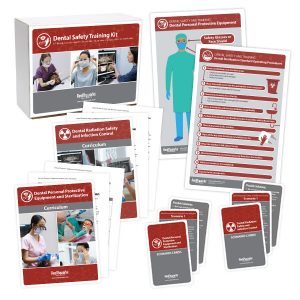
Give your students realistic opportunities to practice key dental safety skills, as well as prepare to become future dental assistants, with our Dental Safety Training Kit. This kit uses interactive, real-world dental safety and sterilization situations to prepare students to earn their National Entry Level Dental Assistant Certification.
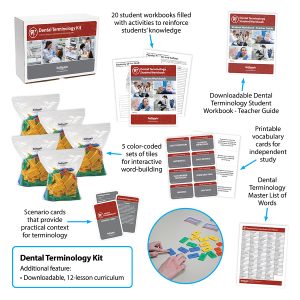
The Dental Terminology Kit is designed to make learning vital dental terminology interactive and memorable. With five complete sets of color-coded tiles, each featuring prefixes, suffixes, root words, and connecting vowels, students can create commonly used terms found in the dental industry. The included scenario cards provide rich, real-world context, allowing students to apply their new vocabulary in practical situations.
Make your curriculum your content backbone
What you teach is just as important as how you teach. Think back to the six key elements – that’s where we can help you. We can help you design your health science program plan of study, the courses and content that you will include. We have dozens of lessons from a variety of curricula provided with our experiential learning resources. We’ve reviewed them and put together a recommended package of content for a dental assisting career pathway.
Once you see the breadth of content that is available, you can begin to figure out how to plug it into the courses you have in your Plan of Study. If you already have some of these experiential resources, you can begin to review the curriculum topics included and see where they best fit in your pathway.
Don’t reinvent the wheel. The lessons are created by educators for educators. There are step-by-step instructions, assessments, slide presentations and ready to use activities.
More dental assisting career program resources
Ready to learn more? We suggest these resources:
- Learn about NELDA exam requirements, including how to apply, how to prepare, and what to expect on exam day.
- Explore tools and resources for creating a dental assisting pathway here
- Watch our complete webinar to get more information on all of the key concepts needed in these programs