 Teaching math in medicine can be a daunting task. Students need to understand foundational math concepts about topics such as fractions, measurement systems, and conversions. Unfortunately, not all students have the same level of understanding on these topics. Use these tips to teach basic medical math skills and integrate foundational math concepts into your health science lessons.
Give the Problems Context
It can be difficult for students to understand math when it’s a jumble of meaningless numbers. Consider rephrasing math equations into terms the students can understand and relate to. Try to think of scenarios that involve math in medicine and can easily be remembered. Students can recall these scenarios in the future when faced with similar problems.
Example equation: 0.1875 mg divided by 1 tablet equals 0.28 mg divided by X mL. Solve for X.
Example equation rephrased as a scenario: An order reads to administer digoxin 280 mcg PO. The pharmacy supply is digoxin 0.1875 mg per tablet. How many tablets should be administered?
Break the Topics Into Bite-Sized Pieces
It’s easier for students to master one concept at a time and build their knowledge of math in medicine up from there. It can be overwhelming for students when they don’t fully understand one topic and the class has already moved on to the next, leaving them to play catch-up.
If you don’t have time to teach one topic per class period, ensure you’re using very clear transitions from one subject to the next. If you don’t use clear transitions, the equations can blur together for students, leading to confusion. You can prevent this by simply and clearly stating, “That’s it for decimals; let’s focus on percentages now.”
Turn Math Practice Into a Game
Gamifying math in medicine can allow students to learn the content at their own speed and level. Creating a sense of competition can encourage more engagement and drive students to improve their skills. Jeopardy and Family Feud are other popular game formats you can use to make learning fun.
You can fill out this form to learn about the Math Fluency Project, a project that gamified math at various levels of education.
Read more about innovative ways to teach with video games in this article by Leila Meyer.
Integrate Math Into Every Lesson
Instead of teaching math as a separate lesson before moving on to lessons about different body systems, teach a lesson on math and continue to incorporate it into every lesson after. Consider adding math problems related to intake and output in a genitourinary unit or dosage calculations for medication in a cardiac lesson. When you teach math separately, students think of it as separate from all the other concepts they learn. They don’t understand that math is part of daily life in health science.

Work Smarter, Not Harder
You don’t need to take it all on yourself. Find some go-to resources to help curate your math content! Kahn Academy is one great tool you can use to teach basic math concepts. You can pick topics based on your students’ grade level and learning needs.
Use the CSC Method
CSC stands for Convert, Solve, and Check. Step one is to determine if there are any conversions necessary to solve their problem. Step two is to solve the problem. Students can solve the problem via one of these three methods: Ratio/Proportion, Desired/Have, or Dimensional Analysis.
The Ratio/Proportion Method has students set up the problem in a fraction format with similar units of measurement across from each other. Then they solve the problem by cross multiplying.

With the Desired/Have formula, the Desired amount is divided by the amount you Have and multiplied by the quantity.

For Dimensional Analysis, students set up the problem in a fraction format with similar labels diagonal from each other to cancel each other out. They will then multiply across the top and bottom. Finally, divide to get their answer.

Students should solve the problem using the method that they’re most comfortable with. Then they should check their work. Checking their work may seem like an obvious step, but when it comes to math in medicine, this step is vital.
Incorporate Hands-on Learning Tools
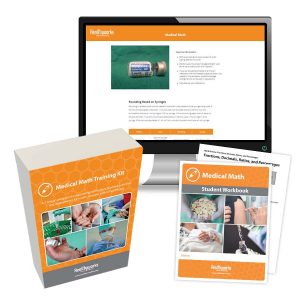
Hands-on tools engage students in what they’re learning and help them make important connections. Our Medical Math Training Kit can help your students reinforce foundational math concepts and introduce them to basic math in medicine. This flexible kit can be used in remote, in-person, or hybrid learning environments to teach the three solving methods above and more. It includes curriculum, workbooks, and interactive online lessons.
More Resources for Teaching Math in Medicine
Looking for more information? We recommend these resources:
- Our blog post, “This Kit Teaches Medication Math to Health Science Students”
- The webinar, “Teaching Math in Your Health Science Program”