Effective  wound care training is essential for preparing future healthcare professionals to provide safe, competent patient care. Yet traditional lecture-based instruction can only go so far in helping students truly understand wound types, dressing selection, and hands-on care techniques. That’s where tools like the Wound Care Simulator make all the difference. By giving learners the opportunity to practice cleaning, packing, dressing, and assessing a variety of lifelike wounds in a controlled environment, instructors can bridge the gap between textbook knowledge and real-world clinical skills.
6 Common Wounds
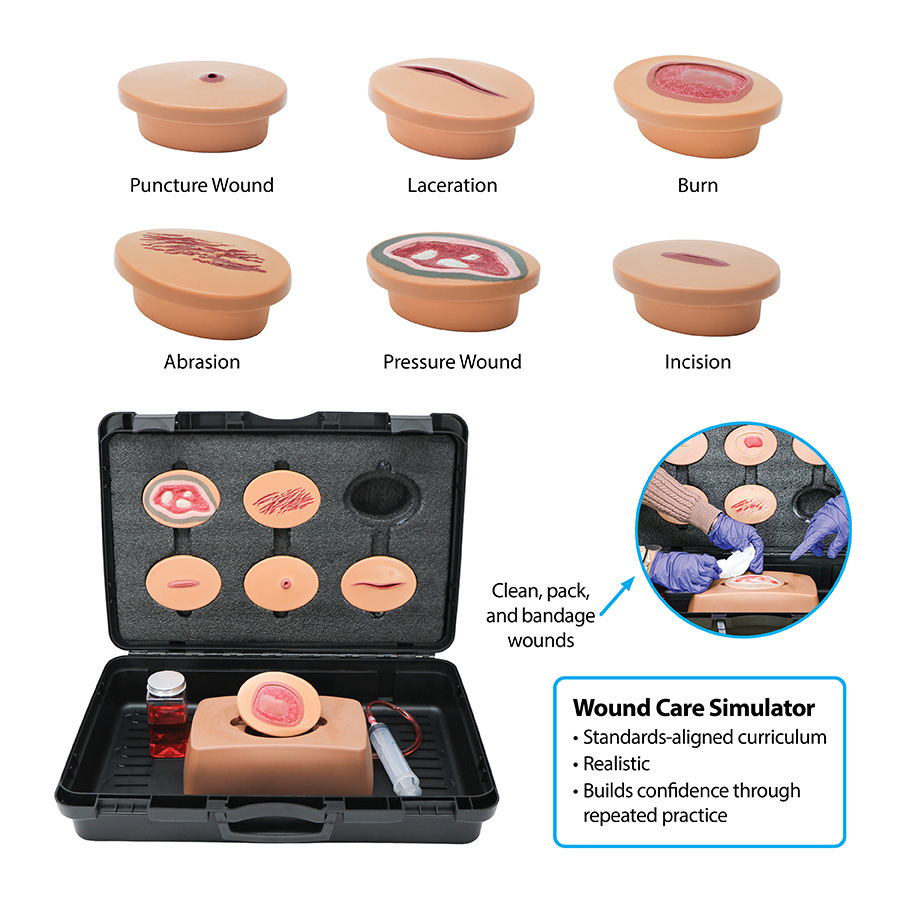
With the Wound Care Simulator, students can practice cleaning, dressing, packing, and assessing six common wounds. Each wound bleeds as you inject simulated blood into this wound care training tool. Just like in the real world, each injury bleeds differently.
Wounds included:
- Puncture
- Laceration
- Burn
- Abrasion
- Pressure wound
- Incision
These wound types help students build foundational skills they’ll rely on in real clinical environments.
Real-World Application
Wound care is a foundational skill across healthcare settings, from hospitals and clinics to long‑term care and home health. By practicing with lifelike wounds that bleed and respond differently, students learn to make quick assessments, choose appropriate dressings, and consider factors like infection risk and healing stages. This kind of experiential wound care training strengthens clinical judgment and prepares learners for the fast-paced decision-making required in real patient care.
Ready-to-Use Curriculum
This wound care training tool comes with a four-lesson curriculum that covers wound assessment and classification, infection prevention and control, the wound healing process, and more. The complete curriculum takes three to four hours to teach, but you can easily pull specific lessons or activities to incorporate into your current lesson plan. It comes with slides, student activities, and assessment tools that align with the NHA Patient Care Technician/Assistant Certification.

Classroom Flexibility
Whether you teach in a health science CTE program, a nursing fundamentals course, or a medical assistant or patient care technician program, the Wound Care Simulator adapts easily to a variety of learning environments. It can be used for skills checkoffs, lab stations, scenario‑based learning, clinical prep sessions, or interdisciplinary lessons. Its durable design also supports repeated practice, making it ideal for individual, small‑group, or full‑class instruction.
Why it Matters: Poor wound care can increase infection risk, delay healing, and lead to serious complications. Teaching students how to properly assess and manage wounds builds confidence — and helps them deliver safer, more effective patient care.
Additional Resources
- Watch our free webinar on bringing healthcare foundations to life
- Download and print free educational posters on healthcare soft skills, healthcare careers, and more
- Check out our free career exploration lesson plans, including one on health science careers