Parenting classes used to send students home with eggs to care for. Now, some get a sophisticated robot that can cost up to $1,000 to replace.
This article was originally written by Stephanie Ebbert for The Boston Globe on January 14, 2020.
The fake babies first showed up at my house for a sleepover with my daughter, Anna. They were not exactly invited. Her three best friends were taking an early childhood class at their high school and their signature assignment — a crash course in caring for a frighteningly realistic doll — landed on the weekend of Anna’s 15th birthday. We told ourselves the shared experience would be fun.
It was not fun.
The lifelike robot babies — one white, one black, one Asian — made for adorable additions to the pictures on Snapchat, but to say they hijacked the fun would be an understatement. They needed diapers changed and bottles administered. They could only be transported in full-size car seats. Were they cute? Yes, but maddeningly needy.
Reality sets in
The all-about-me lifestyle of the modern teenager has no space for needy infants. The girls could have been lolling around on the couches without a care in the world, staring at their phones and liking things at their leisure until boredom compelled them to demand a ride to The Cheesecake Factory. Yet here they were, selflessly tending to the needs of other small creatures. One of the girls was an anxious mess, muttering something like, “I can’t,” while trying to puzzle out what little Liam could possibly need now. Another was exhausted, commiserating with the third about her baby’s especially fragile neck. Splayed across the couches with their fake babies and their diaper bags, the girls looked defeated even before the pizza was delivered.
As the night went on, my daughter grew antsy and asked if I could drive them somewhere.
“What, are you feeling cooped up with the babies on a Friday night?” I asked, perhaps a little too gleefully. “Sorry! I can’t fit all those car seats in my car.”
I went to bed, giggling a little. The girls have never gotten less sleep at a sleepover. Camped out in the basement, they were intermittently awakened by cries through the night. Upstairs, I slept like the well-behaved baby they wished they had, drunk on a big cup of schadenfreude.
This was, I had come to realize, not just immersion training for students who think they want to work with kids. It was birth control.
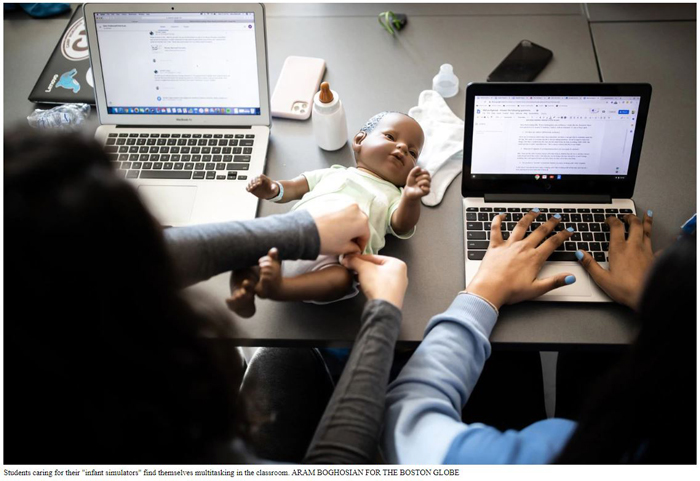
More than an experience
The fake babies were born from a similarly twisted idea. A real-life California couple, Rick and Mary Jurmain, were exhausted by the needs of their two young children. Their firstborn had colic that kept them from sleeping through the night for 11 months. Their second had “a cry that could peel paint off the wall,” recalls Rick Jurmain, who now lives in Burlington, Vermont, to be closer to his adult children. “I literally had to leave the room when she cried,” he adds. (That second baby is now attending law school at Northeastern University.)
It was the early ’90s, when there was incessant hand-wringing about teen pregnancy, and the Jurmains came across a PBS show illustrating how parenting education was then being taught in school: A student carried around an egg or a sack of flour, as if that was a realistic burden.
“I remarked to Mary that a sack of flour doesn’t wake you up in the middle of the night,” he says. “And she remarked flippantly, ‘Well, why don’t you build something that does?’”
RealCare Baby is born
Rick was, literally, a rocket scientist, who was about to be laid off. So he went to the garage and set about designing something truer to life. The first model, named Baby Think It Over, was unsubtle in its message and mostly needed to be comforted when it cried. A proper response involved turning a key in its back and holding it for a while.
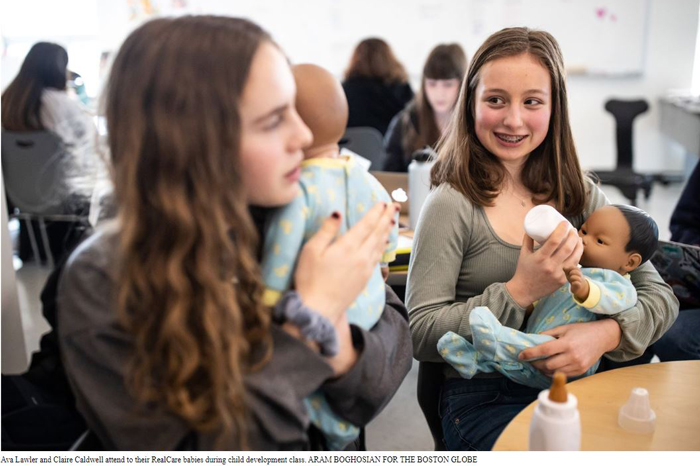
Today, the RealCare Baby 3 infant simulator is a fantastically sophisticated, computer-programmed doll that costs up to $1,000 to replace if you lose it. (I know because I had to sign a waiver; Anna’s school has six of them, provided through a grant from a local education foundation.) The student wears a corresponding wristband that logs his or her responses to the baby through a radio frequency identification tag. Then she — and most of the caregivers are female — has to determine what the baby needs, based on distinctly different cries. “Just like a real baby, you eventually kind of can tell — that’s a fussy, I-just-need-to-be-rocked cry or that’s a really hungry cry,” says Samantha Forehand, marketing communications manager for Realityworks, the small Wisconsin company that makes them.
The fake baby must be fed, burped, changed, and soothed, and though its needs may seem random, its patterns are real. The programming is based on the habits of real babies, logged by real parents. There are 14 different programs with easy, medium, or hard settings selected or randomized by a teacher before the baby is sent off with its caretaker on a Friday night. A weekend immersion program is recommended; by Sunday, the students are usually crying, too.
Continue reading the rest of this Boston Globe article by clicking here.
Are you considering bring RealCare Baby to your classroom?
We recommend following these simple steps.
Do you have RealCare Baby in your classroom already but need assistance using your Babies, evaluating or updating your program?
We can help! Start by reviewing your program.

Hello Casey
We are a small group in the UK. I have ordered from you before. Please could you tell me of a product which will clean the skin of Real baby plus 2 – one of our 5 babies is really marked with black on her face. Also, I need to order some more virtual diapers, so an order form would be very useful.
Many thanks Lynne Vaughan
Mothers Union, Chester. UK.
Thanks for reaching out, Lynne! I’d recommend that you first check out the tips in this blog we wrote; the tips came from our seasoned users regarding their most successful cleaning tips 🙂 Here is the link: https://www.realityworks.com/keep-your-babies-looking-like-new-with-these-realcare-baby-cleaning-tips-free-download/
If these tips do not seem to help, feel free to contact us directly: 800-830-1416 or information@realityworks.com. Thank you!