Our customers have been asking us: How are other teachers using RealCare Baby in a pandemic? In this blog series, we’ll share the success stories of Family & Consumer Science (FCS) teachers who are finding creative ways to do exactly that, virtually and in the classroom. Keep reading to meet a South Carolina FCS teacher who’s making it work, even as she transitions from online to blended teaching.
Missed the first posts of this series? Catch up by reading about Minnesota FCS teacher Trude Sowada here and about Illinois FCS teacher Melissa Priester here.
Introducing Amy Waddell, Family & Consumer Sciences teacher in Bluffton, SC
Amy Waddell is a FCS teacher at Bluffton High School in Bluffton, SC. Although she’s used to incorporating RealCare Baby and other infant simulators into her in-person classes – in fact, this is her 18th year teaching – this school year began on a vastly different note, with no in-person classes at all. Waddell knew she would have to be creative to keep her students’ interest.
“This year has been quite the challenge for us all,” said Waddell, whose students range in age from 14 to 18. “I knew my kids would be just broken-hearted because my program is very well-established and known in our community.”
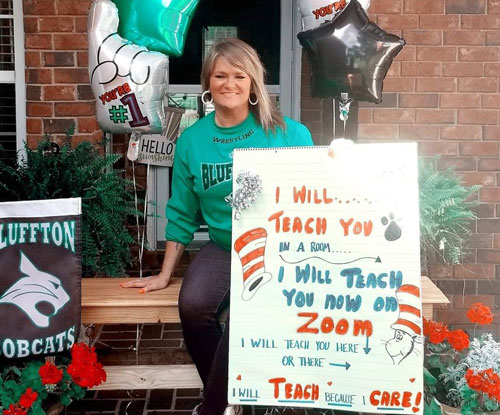
Waddell shared that she teaches at one of just a few schools in her district that use Baby, and her students look forward to the experience every year. In addition to feeling disappointed, Waddell could tell her students were less than enthusiastic about 100% virtual instruction.
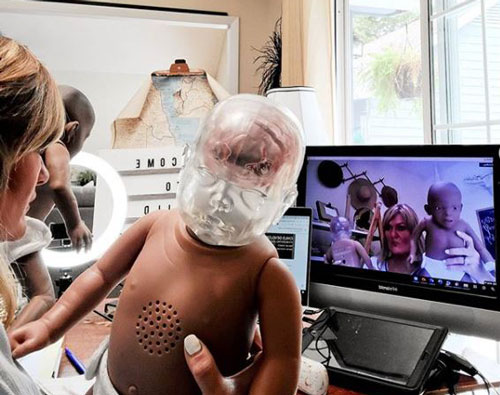
“I was teaching from home and the kids were just down,” said Waddell. “All of the changes were just heavy… so, in an effort to boost morale and keep the students as engaged as possible, I brought the Babies with me to Zoom class one day… and they loved it!”
Grabbing and keeping her students’ attention
According to Waddell, her students “finally woke up and participated” in virtual classes the moment she introduced her infant simulators. In addition to 50 Babies in her program, Waddell uses the RealCare™ Shaken Baby Simulator, the RealCare™ Fetal Alcohol Syndrome Baby and the RealCare™ Drug-Affected Baby.
“I began to introduce different elements of the RealCare curriculum, and it brought my students out of their slump,” said Waddell. “The students’ personalities finally began to show; they had some excitement and their attitudes about school began to change.”
Before “introducing” her virtual students to the infant simulators, Waddell spent time testing various lighting configurations and computer placement. She quickly realized how helpful it was to have a second monitor, and will use one for her webcam while the second shows her lesson plans. She’ll spend a few class periods discussing lesson topics: Shaken Baby Syndrome, Fetal Alcohol Syndrome, infant safety and healthy choices.
Waddell will also spend a few days discussing the specific features of each simulator. Her goal is to prepare her students for what they’re about to see, and to generate excitement, before she displays her infant simulators on her webcam.
“Then, I’ll turn my camera on – and the moment I do that, the students come alive,” said Waddell.
Creating safe hands-on experiences
On October 5, Waddell welcomed two-thirds of her students back to in-person teaching, while one-third remains virtual. She’s made plans to enable all her students, whether they’re learning in person or virtually, to check Babies out for overnight simulation experiences. When each Baby is returned, Waddell will clean and sanitize the simulator and its clothing, then leave it sit out for a week before the next group of students take them home.
“You have to give really good instructions, but they’re just so happy to do it,” said Waddell. “Really, the Babies have brought normalcy back to the classroom. These students can’t touch anything; they can’t participate in group activities… but the curriculum these Babies help teach is so important.”
Waddell said that although many of her students babysit, or have little brothers and sisters, the simulators help make the concepts she’s teaching real.
“My students will tell me, ‘Miss Waddell, I may never need a periodic table again, but everything I do in this class, I will need to know. And they mean it,” Waddell said. “I also teach Foods and Nutrition. Only one student is allowed in the kitchen area to cook at a time… but we’re making ways for kids to still be able to have these hand-on experiences. And those experiences are even more important now.”
Resources for continued learning
Missed the first posts of this series? Catch up by reading about MN FCS teacher Trude Sowada here, and about IL FCS teacher Melissa Priester here.
Use the below resources to learn more:
- Blog: “3 RealCare Baby Lessons You Can Facilitate Online”
- Blog: “7 Steps to Successful RealCare Baby Deployment (Whether You’re Teaching Remotely or In the Classroom)”
- Case study: Engaging 21st Century Family & Consumer Sciences Students: The Impact of Infant Simulators
- Free guide: RealCare Baby Implementation Guide