Nellie Garrow-Coleman, LCSW-R, has worked in education for 23 years. For the last four years, she has supported students at The High School of Arts and Technology on the Martin Luther King, Jr. Campus in New York. About a year ago, she started using a popular Baby simulator to assist her teen pregnancy prevention efforts. One year later, RealCare Baby® has helped her teach over two dozen students valuable life lessons.
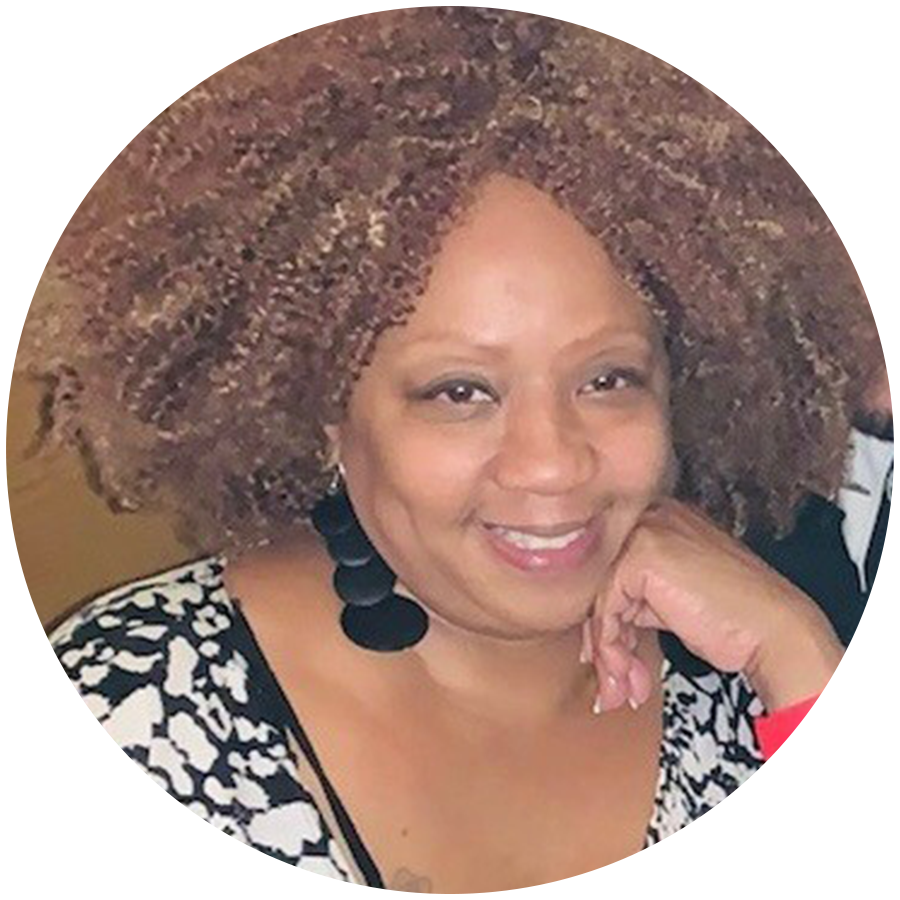 “Students benefit from the program and learn, growing in so many ways. They learn about themselves, their life and career choices, attitudes about parenthood, the financial and emotional responsibility of raising a child, and different types of families. They also connect with parents in a different way.”
Nellie Garrow-Coleman, LCSW-R
Social Worker, Attendance Coordinator
The High School of Arts and Technology
New York, NY
Garrow-Coleman supports students in temporary housing as a licensed professional social worker and attendance coordinator.
“Everybody has a story. Once you learn why kids don’t come to school, you get a clear picture of what’s going on in their life,” she said. “I look beyond the immediate individual to what’s impacting them from a more holistic point of view… and then I try to re-engage them back to the school community, or a different alternative.” 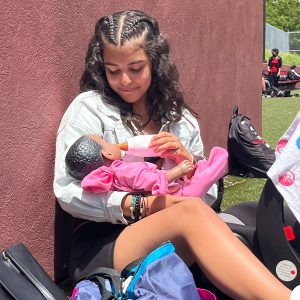
In her work, Garrow-Coleman has seen many students in high school, and sometimes middle school, become parents. She felt compelled to start a RealCare Baby® program focused on teen pregnancy prevention. She contacted her school’s Condom Availability Program to learn how to get started, and they directed her to Realityworks.
“Ms. Coleman came to me last year and said she was interested in piloting a program with RealCare Babies to help students learn in a very hands-on way what it means to care for a baby,” said Mariela Graham, Principal of The High School of Arts and Technology. “Over the course of the last school year, we have had close to two dozen students participate in this program, which included an introductory session, real-world experience with the RealCare Babies, and debrief sessions in which students were able to articulate what they learned from the experience.”
Meet the learning aid
Realityworks developed the RealCare Baby infant simulator (Baby) over two decades ago to address teen pregnancy prevention. Today, the world’s most advanced baby simulator remains a unique learning aid. Educators use it to address early childhood education, parenting, infant health lessons, and sex education.
Baby tracks caregiver behaviors to keep users accountable. It provides reports on care events such as mishandling, time spent in a car seat, and clothing changes. Additionally, it includes four sets of curriculum and student activities to help instructors create learning experiences relevant to their class’s goals.
“I love that part of your curriculum is geared towards middle school, because that’s real life,” stated Garrow-Coleman. “I’ve had previous students who were entering high school with children already. We need to support our students early on with this information and these resources.”
Volunteering to learn
With these resources, Garrow-Coleman began her Baby program in the fall of 2021. Unlike the typical Baby program, her program is entirely voluntary. Students hear about the program through word of mouth. If they’re interested, they seek out Garrow-Coleman to sign up.
Students choose to enter the program for a variety of reasons. One participant almost had a baby of her own and wanted to know what that experience would have been like. Some students just wanted to check out the experience and learn something new.
We asked 11th-grader Carlos Matos why he joined the program.
“I had crazy baby fever,” he told us. “I always wanted a kid, and I didn’t care if it would have been at a young age.”
He explained that only the good parts of parenting had been highlighted for him and he wanted to see what it would be like for himself.
Garrow-Coleman and her student ambassadors, in collaboration with the health teacher, also presented to two Health classes. These presentations help spark other students’ interest in volunteering for the RealCare Baby program. She hopes to expand this partnership as well as her baby simulator program in the future.
Students leading students
Garrow-Coleman gives interested students a release form before having them complete the survey and self-assessment form included with her Babies. Once all the documentation is complete, she sets up time with the student to review a slide presentation about the program.
The presentation is led by 11th grade “student ambassadors” who were the original participants in the program. It incorporates their experience with the Babies as well as the impact the program had on their families, life, and career goals. They discuss family reactions before and after, simulation report cards and self-reflection.
Reviewing this information helps new students understand the experience and set expectations. Upon completing the presentation, students can pick their Baby simulators up at the end of class on Friday and embark on their three-day parenting journey.
Learning from experience
Many of the students initially thought of Baby as a cute doll and viewed the experience as a game… until Baby started waking them up at 3 a.m.
“It was so annoying. It cried so much,” Matos said. “I don’t want to go through this ever again.”
After completing the simulation, Garrow-Coleman meets with the student to discuss the highlights and challenges of their experience. They talk about how the student is feeling, how their family reacted, what it was like to care for Baby in public, and more.
“It definitely opens up a lot of family discussion,” stated Garrow-Coleman. “It impacts the whole family, just like a real child would.”
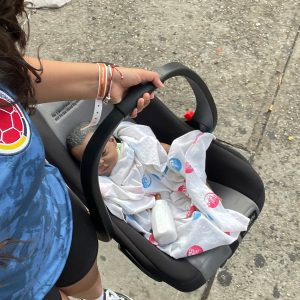
Students also expressed how shocked they were by the judgmental attitudes they experienced when out in public with Baby.
“You get a lot of negative comments. You get a lot of weird looks because, honestly, they see you as a kid with a kid,” stated Destiny Boyd, a recent Baby program participant. “But, at the end of the day, you’re a human. You had a baby; you take care of the baby like any other human would. So, the judgement was challenging for me.”
“I had the opposite experience,” said Matos, who explained that while girls in the program were judged negatively, he was praised for being a good father and taking care of his baby. He stated, “I understand that people are way more judgmental toward girls.”
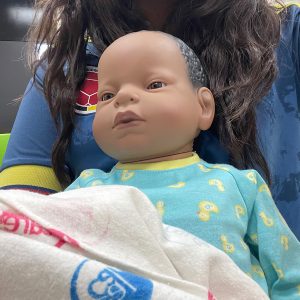
“We even talked about colorism,” said Garrow-Coleman. Most of her students are of color, and the various complexions of the Babies initiates a conversation regarding colorism and the effect on people of color. The Baby simulator program also opens dialogues about relationships, practicing safe sex, and what kind of a partner each participant would want to raise a child with.
A lasting impact
Garrow-Coleman talks to students about how different cultures react to and handle teen pregnancy. They discuss potential health issues an infant can have, life goals, careers, and the impact of having a baby as a teenager. After completing the program, participants agreed that they now have much more respect for parents in general. They agree the program is a worthwhile experience for everyone.
“I encourage people to try this because there’s a lot of people like me who wanted a baby,” stated Matos. “It was a real eye-opener.”
Ashly Espinal, another student from the program, said, “The Baby project changed my mindset so much and it made me respect teenage moms a lot more.”
Boyd stated that the program helped her become more confident, explaining that she was initially embarrassed to be seen with Baby at first. However, by the end of the project, she would leave Baby uncovered for everyone to see.
“Although challenging, the teens loved the program,” said Garrow-Coleman, who hopes to expand her program in the future. “Students benefit from the program and learn, growing in so many ways. They learn about themselves, their life and career choices. They reflect on attitudes about parenthood, the financial and emotional responsibility of raising a child, and different types of families. Students also connect with parents in a different way.”
“Nothing replaces personal interactions and real-world learning,” stated Principal Graham. “The understandings and realizations that students had as a result of this experience could not have been replicated in any other way.”
Learning tools used:
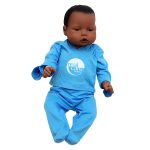
RealCare Baby® 3 Infant Simulator
RealCare Baby® 3 (formerly known as Baby Think It Over® or BTIO®) is the world’s most advanced infant simulator. Educators around the world use this unique learning aid to teach early childhood, parenting, infant health lessons, and sex education.