Hannah Cooper is an assistant professor at Tidewater Community College’s Occupational Therapy (OT) Assistant Program in Virginia Beach, VA. In 2021, she was approached by her program director, Amanda Leo, about using Realityworks’ RealCare™ Geriatric Simulator in her occupational therapy classes. Since then, she has used the wearable suit, as well as Realityworks’ Geriatric Sensory Impairment Kit and Hemiplegia Simulator, to give her students first-hand experience with geriatric impairments.

“[We’re] trying to equip them to start to feel comfortable with the clinical skills they need in order to become effective therapists… With these tools, they can build their confidence and be more effective as students and ultimately as practitioners.”
Hannah Cooper
MSOT, OTR/L, OTA/L
Assistant Professor, Academic Fieldwork Coordinator
Occupational Therapy Assistant Program
Tidewater Community College in Virginia Beach, VA
“As a director, I was immediately drawn to the increased opportunity for engagement that the simulators would bring as instructional methodologies to facilitate hands-on learning, critical thinking, and clinical reasoning prior to direct patient care,” Leo stated. “In a sense, the supplies and resources from Realityworks have become a critical component in bridging didactic and clinical education!”
Cooper first started using the simulators in her OT with Physical Disabilities course. In this class, students practiced transfers and basic functional mobility while wearing the simulators to help them connect the topics they learned in class to the work they will do in the future.
“We want to try to connect as much as possible what it’s like to work with real-life clients . . . before those students go out on field work,” said Cooper. “The simulators are helping [students] understand how their clients are experiencing [the] world.”
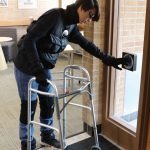 With five years of experience as a certified OT assistant working with geriatric clients and one Geriatric Simulator A wearable age simulation suit year of OT experience working with pediatric clients, Cooper understands how valuable it is to connect people she’s worked with to the material students are learning. However, students don’t have that real-world experience to draw from. What’s more, there are limitations to the types of realistic experience they can have. These tools let students see how each impairment on its own can affect a client’s life, as well as the experiences of clients with multiple impairments.
Specifically, the Geriatric Simulator allows students to experience a variety of age-related physical challenges, such as stooped posture and restricted range of motion. This experience helps them develop sensitivity and understanding toward their future geriatric clients. The Geriatric Sensory Impairment Kit helps students understand sensory challenges elderly clients often face. It includes simulators for hearing impairments, arthritis, and tremors. The Hemiplegia Simulator enables students to experience paralysis on one side of their body. This is helpful in developing an understanding of disabilities due to stroke or similar conditions. All three wearables include comprehensive curriculum.
Cooper teaches a 15-week therapeutic skills course in which she addresses different impairments and what tasks would be challenging for those experiencing such limitations. After learning these concepts, Cooper has students put the simulations on and try to complete simple daily tasks, such as putting clothing on or climbing stairs.
Cooper said her goal is for students to “relate to [clients] better and be able to have better empathy or sympathy.” This allows her students to “be better practitioners because they’re able to understand, to some extent, what [the clients’] experiences are.”
“I’m really grateful for the [curriculum] with guiding questions for the students,” stated Cooper. She has her students complete some reflection questions from the curriculum after attempting occupations with the impairments. Cooper explained that this helps the students “generalize what [visual impairment] would be like from the singular experience they had.”
“I like the ‘talk about it, demonstrate it, do it’ method,” said Cooper. She can tell students are making the connections by watching their faces as they use the simulations. “You can see those wheels turning; you can see their eyes lighting up.”
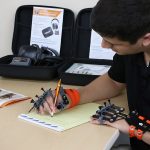
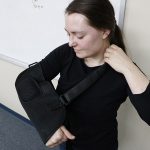 Cooper explained that when students use the full Geriatric Simulator, they start to understand the breadth of limitations some of their clients face. Instead of trying to imagine what these impairments are like, they can experience the limitations for themselves.
“The time [it takes] to put on all of [the simulator’s] components has been helpful for them to realize just how significant the impact is on a client’s life,” said Cooper. “I think it’s helped [clients’ challenges] become more real to them.”
Cooper told us her students are often surprised by how limiting the impairments can be. For instance, she’s heard students remark on how startling it can be to suffer from an impairment that impacts their ability to see, or how difficult it is to concentrate when suffering from a hearing impairment.
“I think that’s really helped them have more compassion,” stated Cooper. “And that’s really important in healthcare, especially in today’s climate.”
Using the curriculum as a guide along with homework, students can express what they experienced, how using the simulator felt, and how the impairments can impact other parts of their clients’ lives. After students write their responses to the curriculum’s prompts, Cooper facilitates a class discussion in which students share what their impairment and task were as well as one of their written responses.
“They’re able to see what it’s like both as a client and as a practitioner,” said Cooper. “It’s not just hearing loss. It’s hearing loss and a decrease in mobility or a decrease in functionality throughout [the client’s] day.” Students not only experience a singular impairment with the simulations, but several limitations together — which gives them a better understanding of how these impairments relate to each other and affect clients’ lives.
“[We’re] trying to equip them to start to feel comfortable with the clinical skills they need in order to become effective therapists,” stated Cooper. “With these tools, they can build their confidence and be more effective as students and ultimately as practitioners.”
Learning tools used:

RealCare™ Geriatric Simulator
Use our award-winning RealCare™ Geriatric Simulator to help students develop empathy towards older patients and individuals with limited mobility. This wearable simulator enables students to personally experience a variety of physical and visual challenges, like stooped posture, restricted range of motion, glaucoma and more.

Geriatric Sensory Impairment Kit
Use the Geriatric Sensory Impairment Kit to help students understand common sensory challenges faced by older adult patients and develop geriatric nursing skills. This kit includes the Hearing Impairment Simulator and Geriatric Arthritis Simulator, as well as the Geriatric Tremor Simulator.
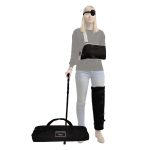
Hemiplegia Simulator
The Hemiplegia Simulator is a wearable simulator that enables users to experience paralysis on one side of the body (hemiplegia). This helps them to gain an understanding of patients’ or family members’ disabilities due to stroke or similar conditions.