When James Quick began teaching agriculture science at Surry Community College in North Carolina five years ago, the goal was to reignite the college’s agriculture science program, which had fallen to the wayside after the former head of the program retired. Since then, Quick, the lead agriculture science instructor, has worked hard to grow the program.“We’ve made leaps and bounds. We now have a farm on campus with a couple of animals,” said Quick. “The goal of the program is to promote agriculture because that interest is on the decline.”
Most of Quick’s students have no prior agriculture science experience beyond a high school animal science class. Surry Community College offers diplomas and certificates in animal science. Those enrolled will learn all about beef production, postproduction, animal health management, and more.
“Most of my students are coming from a family farm, so they take a lot of what we go over in class and apply it in their real-life scenarios,” said Quick.
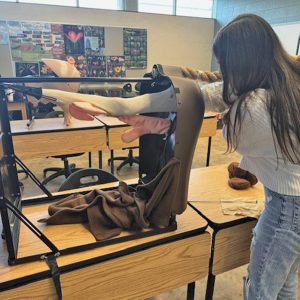 While the agriculture science program has made a lot of progress in the last five years, Quick is still focused on growth. To recruit students, Quick hosts an Agriculture Day in April for local high schools. Students can play games, see animals, and hear about and sign up for Quick’s classes.
“I usually have a few of the Realityworks models out there and there will be a student responsible for working the table. For example, we got Teresa, which is the [Pig Model] where you can take everything out,” explained Quick. “Visitors would come by and try and name the organs and put them back in place.”
Quick frequently visits high school agriculture classes with his models and simulators, which all have names, hoping to spark their interest and recruit them to his program. One simulator that inspired a lot of student interest was Coco, the Bovine Breeder™ artificial insemination simulator.
The Bovine Breeder is a unique learning aid that teaches correct cervix manipulation, AI gun positioning, and pregnancy palpation. It allows agriculture science students to see inside the reproductive tract to identify reproductive system landmarks. Students can also learn correct techniques for inserting and delivering semen. The simulator aids in teaching how to palpate the uterus to identify stages of corpus luteum development and pregnancy.
“All the students love Coco because they can get a little more interactive with her,” said Quick. “I used to take her around because she always garnered a lot of attention. I had to stop taking her around because students were being a little rough. Now I take Wilbur, which is the [Dissected Fetal Pig] model.”
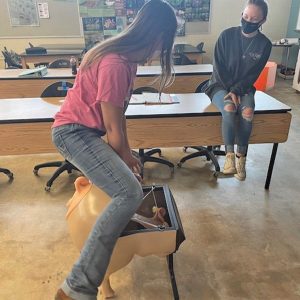 Quick also has a Swine Breeder™ artificial insemination simulator named Teresa.
“Teresa is very anatomically correct, and we use this animal model to review the reproductive organs,” explained Quick. “The students are able to practice artificially inseminating, which is a very common practice used in swine production.”
One benefit of Realityworks’ agriculture science models and simulators is that they come with standards-based curricula, something Quick uses in his own classes.
“They’re a great template and even if you don’t use them word-for-word, it gives you something you can build upon,” said Quick. “I think it’s good for someone first starting out or just in general… Just because you teach something doesn’t mean you have 10 years of experience doing it. It’s good to have that base knowledge that at least gives the teacher something to start with. A teacher may have all the experience in AI, but they maybe can’t put that into an easily understandable slide with visuals. It’s good that you provided that for them, especially in this field.”
Before obtaining their own farm, working with agriculture science models and simulators was as close as students could get to skills training outside of field trip opportunities. Quick found that this hands-on learning sticks with students more so than traditional lectures.
“We could go over slides on AI and anatomy but being able to see something that’s very close to the real thing definitely, I feel, drills that more into their head,” said Quick. “They truly do enjoy it.”
When it comes to exam time and agriculture science students are struggling to come up with an answer to a question, these experiences are likely to stand out.
“You’ll remember the day you stuck your arm in Coco’s rear end… You may not remember the notes or the slides, but you’ll remember that. That should help a little bit,” said Quick. “Especially when we use Wilbur because we use Wilbur before we dissect actual fetal piglets. They can get an idea of what they’ll see. Wilbur is a lot larger than the fetal piglets, so they can see things a lot clearer.”
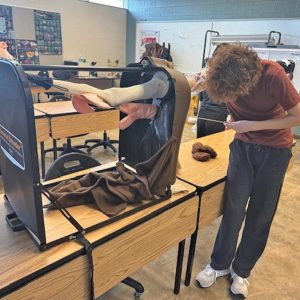 Now that Quick has real animals for his agriculture science students to work with, the models and simulators are no longer the final step in the learning process. However, they’re still useful when training students before they work with the real animals. Students start with notes and worksheets before working with models and simulators. Once students feel confident on the simulators, they can graduate to the real animals.
“It’s great to practice with that plastic model before we get into the real animals,” said Quick. “I think it’s still definitely needed.”
Quick can tell the agriculture science models and simulators are working by seeing how they do on the practical, or applied exam, in which students must demonstrate the process of AI. The practical is a large part of the students’ grade and they’re able to come in and practice with the simulators at any time. Quick emphasizes that even though students are using a simulator, they must perform all the steps they would with a real animal.
“You have to pretend that Coco has a beating heart. That’s the only way you’re going to get an A.” said Quick. “Animal welfare has always been super important to me. I think that’s why, originally, I thought I want to be a vet. I just always loved animals. I wanted to basically take care of something that couldn’t take care of itself or at least communicate sometimes if it’s in pain.”
Quick stresses the importance of animal welfare and its impact on how the animal tastes. Additionally, he ensures his agriculture science students understand that every part of the animal should be used.
“These animals are sacrificing their lives. None of it should go in the trash. If it’s for you, if it’s for your crops, your plants, if it’s for your pet food, if it’s for research, they’re sacrificing themselves. We should make sure we take good care of them,” said Quick. “They’re here for us, our sustenance. We should at least respect them.”
Learning tools used:
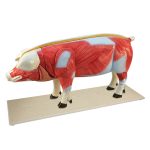
Pig Model
This model seperates at the midline, it reveals 16 removable organs and body parts including the digestive as well as reproductive systems.

Bovine Breeder™ artificial insemination simulator
This simulator is a unique learning aid that teaches correct cervix manipulation, AI gun positioning and pregnancy palpation. It allows students to see inside the reproductive tract to identify reproductive system landmarks.
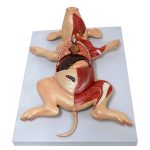
Dissected Fetal Pig
This detailed model of a dissected fetal pig brings hands-on experience to the classroom. It features removable organs as well as a curriculum which discusses fetal pig anatomy and dissection techniques.

Swine Breeder™ artificial insemination simulator
Use this simulator to teach proper swine artificial insemination and birthing techniques. This sturdy, portable tool allows students to sit on it while checking for standing heat and replicate artificial insemination techniques.