As we shared in a recent blog, a good anatomical model brings engaging, hands-on learning to a variety of important agriculture topics. It should look real, teach what it says it will and match the curriculum and academic standards used in the classroom. We took those requirements to heart when developing our own line of animal anatomical models back in 2017, and we’ve maintained those standards since. Today, we’re proud to offer an entire line of animal anatomical models that engage today’s ag students and teach important skills… and although admitting favorites is difficult, here are 3 reasons we love our Cow, Pig and Horse Models.
Reason #1: Anatomically correct scaled models
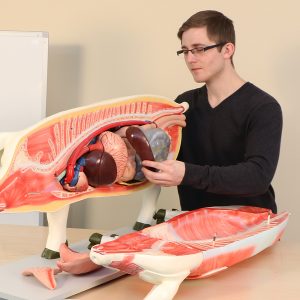
We know that hands-on learning resonates with today’s Generation Z students. They’d rather see, touch and feel a learning aid than read about a concept in a textbook. That’s why all of our animal anatomical models separate at the midline to reveal anatomically correct, scaled organs and body parts. Students can remove the organs from our Cow Model, Horse Model and Pig Model to study each organ up close to get a better understanding of each animal.
Reason #2: See inside major organs and systems
Once our Cow Model, Pig Model and Horse Model are separated, students can remove various organs and body parts as they study each one’s reproductive system, digestive system, and, in the case of the Cow Model, the udder structures. Better yet, those removeable organs are magnetized! By challenging your students to reassemble each animal, you can make your lessons truly memorable – and, as one educator recently shared with us, “students are having fun while learning anatomy.”
Reason #3: Realistic textures and details
You know you have a good anatomical model when your students buy into it – after all, today’s students want to be able to connect what they’re learning with the real world. We considered this when creating our animal models. As a result, our models feature realistic details of both external and internal animal anatomy. The reticulum of the Cow Model, for instance, resembles the honeycomb texture found in the real animal, and it’s easy to identify the rumen, the omasum and the abomasum.

Learn more
If you’re looking for more information on using animal anatomical models, we recommend these resources:
- Blog: “30 Useful tools to prepare your Ag students for FFA competitions“
- On-demand webinar: “Cool Tools for Engaging Today’s Agriculture Students“
- Free guide: “Agriculture Program Implementation Guide“