Americans are aging, and they’re aging quickly. The Urban Institute reports that the number of Americans ages 65 and older will more than double over the next 40 years, reaching 80 million in 2040, while the number of adults ages 85 and older will nearly quadruple. In fact, the US Census reports that older adults will outnumber kids by 2035.
The impact of these trends can be seen in places like Park Hills, Missouri, where students pursuing health care careers at Mineral Area College (MAC) are spending more time than ever before preparing to care for elderly patients. For the last three years, MAC nursing staff have coordinated a Geriatric Sensory Workshop, dedicating at least one full clinical day to progressing students through a series of geriatric sensory stations to help them develop empathy and sensitivity toward older patients. As students practice patient care skills while wearing age simulation suits like the Geriatric Simulator from Realityworks, Inc., they develop a better understanding of what their real patients are going through.

“You can watch videos all day, but once you put a student into that situation, it’s a totally different experience,” said Sadonya Suttles, M.S.N., R.N., Assistant Professor and Simulation Lab Coordinator at MAC. “We made our own simulators for a while, but with so many elderly patients in the hospitals, we’ve been able to focus so much more on these skills. And the students love it.”
Sadonya Suttles
Assistant Professor, Lab Coordinator
Using funds from the MAC Foundation Enhancement Grant Campaign, which provides a $3-for-$1 match for the development and expansion of career education tools, MAC purchased Realityworks’ Geriatric Pathway Package in 2019. The package includes a Geriatric Simulator, Geriatric Foot Care Model, Geriatric Medication Management Simulation Kit, Geriatric Sensory Impairment Kit, Hemiplegia Simulator and other interactive learning aids designed to help students interested in health care careers experience the challenges elderly patients face on a daily basis.
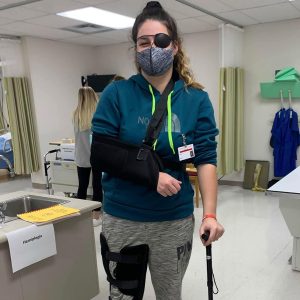
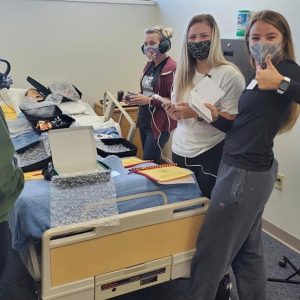
Currently, associate degree nursing students and practical nursing students get one full day in the Geriatric Sensory Workshop as they prepare for clinicals. Students wear the weighted vest and other components of the Geriatric Simulator as they use a walker and breathe through a straw. Students wear the glaucoma glasses and gloves that come with the Geriatric Medication Management Simulation Kit as they try to read prescription details and open the correct pill bottles. They try buttoning shirts while wearing gloves and walking with canes and crutches. When they’re able, MAC staff volunteer as patients, wearing the simulators while students practice caring for them.
“Students tell me all the time – oh, my gosh, I can see now why my respiratory patient is having problems walking to the bathroom, why they’re struggling to do this or that,” said Suttle, who uses pre- and post-assessments to measure workshop impact. “Students may have seen these things, but once they experience it, they are so much more empathetic towards the patients.”
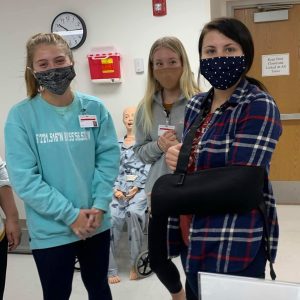
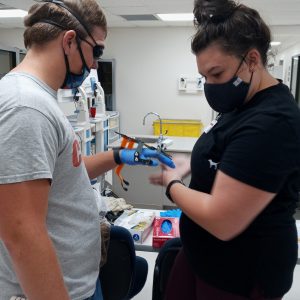
When the COVID-19 pandemic made accessing facilities for clinical hours a challenge, Suttles says the Missouri State Board of Nursing approved the use of simulations so students could still meet their clinical hour requirements. Suttles used items like the Geriatric Skin Conditions Kit on manikins and standardized patients to provide more true-to-life learning opportunities.
“The skin conditions in particular were great because it gave students the chance to still see that kind of thing, even though they couldn’t access real patients,” said Suttles.
As Suttles prepares for a new school year that is likely to feature more in-person learning but could still limit access to facilities, she looks forward to featuring her geriatric simulators in the Geriatric Sensory Workshop and throughout each course as needed to ensure her students get as much real-world, hands-on learning as possible to prepare them for their future health care careers.
“Students regularly tell me how much they wish everyone could experience this, how much the experiences put things into perspective. Even my older students, the ones who have some life experience, are amazed,” said Suttles. “We can’t wait to use them again.”
Learning tools used:

RealCare™ Geriatric Simulator
This wearable simulator enables students to personally experience a variety of physical and visual challenges, like stooped posture, restricted range of motion, glaucoma and more.
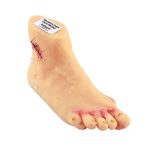
Geriatric Foot Care Model
This detailed, life-sized Geriatric Foot Care Model features a variety of conditions. These include bunions, corns, nail fungus, athlete’s foot, plantar warts, ingrown nails, diabetic ulceration, heel callus, and sutured laceration.
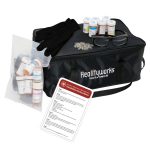
Geriatric Medication Management Simulation Kit
Help students build empathy and understanding of the challenges experienced by older adults who have multiple medications to manage.

Geriatric Sensory Impairment Kit
Use the Geriatric Sensory Impairment Kit to help students understand common sensory challenges faced by older adult patients and develop geriatric nursing skills.
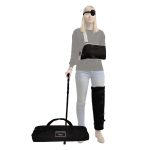
Hemiplegia Simulator
The Hemiplegia Simulator is a wearable simulator that enables users to experience paralysis on one side of the body (hemiplegia).
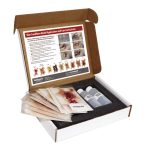
Geriatric Skin Conditions Simulation Set (9 skin conditions)
This kit includes 9 realistic models of common geriatric skin conditions. Students can adhere these models to human as well as manikin skin and examine the detailed tissue.