
“We try to provide our students with as much hands-on practice as possible before they enter their practicum courses and get internships,” said Animal Science Teacher Melissa Barnett. “Especially this year where we’re not able to go places and have field trips and guest speakers, do all the normal things we’re usually able to do… we use these models to give the kids a lot of hands-on experience and let them see as much as possible before they go out into industry.”
Melissa Barnett, Animal Science Teacher
Students who enroll in TECCW’s agriculture program start with Melissa Barnett, who teaches Principals of Agriculture, Animal Science, Small Animal Management and other introductory courses. Students can advance to a research-based practicum course in animal science with Barnett or embark on a veterinary science pathway, which Espinosa leads. Both programs culminate in rigorous internships with industry professionals, whether in local veterinary clinics or jobs related to livestock or conservation, some for a minimum of 300 hours. Students can earn industry-recognized certificates as they progress.
Hands-on Training is Essential Every Step of the Way
Using funds from new facility grants, Barnett and Espinosa kicked off their inaugural program year by purchasing a variety of hands-on learning aids from Realityworks. Their purchase included the Bovine Breeder™ artificial insemination simulator, Bovine Injection Simulator, Cow Anatomy 3D Flip Chart and Beef & Pork 3D Meat Cuts Poster. It also included the Cow Model, Goat Model and several other animal and animal skeleton models.

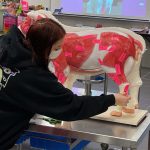
“The first time we used them and the students realized they opened up and have organs in them, they were so excited!” Espinosa recalls of introducing her students to their new animal models, which separate at the midline to reveal removable organs and body parts. “They’ve really thrived learning from them, and they don’t even realize they are learning – they’re just having fun.”
Denisa Espinosa, Animal Science Teacher
Keeping Learning Fun
Keeping learning fun is particularly important to both instructors given the 2.5-hourlong, double-block class periods the program uses.
“Even things that would be fun in short periods of time are not necessarily fun if you’re doing them for 2.5 hours,” said Espinosa. “We’re really thankful to have all these models and simulators so when our students get tired of what we’re doing, we can pause and take out the models. It gets them up and moving, even if it’s something that’s relatively tedious and labor intensive, like looking up the majority of superficial muscles of a large animal. We recently did that, and they had a ton of fun. For something that should have been tedious, it really wasn’t – they were up and moving around, working together. It was awesome.”
According to Barnett, another benefit of Realityworks’ simulators and models is the instructor resources that accompany each one. With TECC-W’s new facility comes the opportunity to teach some classes for the first time, and quality supporting materials help.
“This year is my first year teaching small animal management, and I didn’t have a lot of posters or models because we hadn’t taught it before,” said Barnett. “Having the Realityworks models has been a huge benefit in giving me some talking points. Even the worksheets that come with the models are super valuable as we teach these new courses.”
Favorite Learning Aids
Espinosa says her favorite new tool is the Bovine Injection Simulator. Before purchasing the simulator, Espinosa had students practice ear tagging on scraps of leather. They practiced haltering on stuffed animals. Now, Espinosa’s students practice on the life-size simulator.
“When we found out all the ears were replaceable, we were so excited! I handed each student an ear tag and tagger, and they got right to work,” said Espinosa. “Having the actual boning of the veins in the replica ears, and having to figure out the angle that you’re going to do the ear tag – everything is just more realistic.”
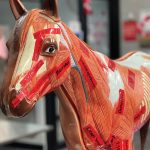
Realistic details like these make lessons more meaningful, especially for visual learners. Barnett experienced this when she used her Horse Hoof and Cow Hoof, both of which feature intricate cross-sections of internal and external hoof anatomy.
“So many of our students see a hoof, and they don’t realize there are structures, that it’s protecting all those important, sensitive parts,” said Barnett. “Having that hoof that’s cut in half so you can see all the bones and everything is a really, really great visual for the students. Plus, we were actually able to get a real horse hoof and leg as part of our dissections this year, so we cut it in half and students were able to just go in and label everything because they’d already seen it. It made the transition really seamless for them.”
A Positive Program Impact
 Such consistent, realistic learning opportunities have a positive impact not only on their students, but on their program budget.
“We do some dissections, but those are expensive and it’s a one-time use,” said Barnett. “With these guys, we’re able to sanitize them and use them year after year. Not having to re-purchase really helps out our classroom budget so we can prioritize certain dissections that maybe we couldn’t otherwise do.”
As a career center, TECC-W is designed to help students discover careers that align with their education and interests. With students coming to the center from five area high schools, recruitment is important – and their new learning aids can help.
“They’re such great visuals! They draw people to our table, start conversations,” said Espinosa. “We recently had a drive-through open house, and we took as many models as we could fit on a table, rolled our Bovine Injection Simulator outside – and everyone just lined up.”
Some of Barnett’s students recently spoke to local elementary school students via video conference about the opportunities available to them at TECC-W.
“Without even being asked, my students selected the horse and cow model to discuss and show off,” she said. “They wanted to show the other students ‘the cool things they will have in high school when they get here.’”
Learning tools used:
- Bovine Breeder™ artificial insemination simulator
- Bovine Injection Simulator
- Cow Model
- Goat Model
- Sheep Model
- Large Dog Model
- Small Dog Skeleton Model
- Cat Skeleton Model
- Cat Model
- Rabbit Model
- Cow Hoof Model
- Cow Anatomy 3D Flip Chart
- Horse Hoof Model
- Beef & Pork 3D Meat Cuts Poster
- Large Injection Pad