Today’s students crave experiences. Textbooks and lectures just don’t cut it. The Generation Z students sitting in your classroom or sim lab want you, as their guide, to learn – and make mistakes – right along with them. Ideally, this learning would occur through hands-on learning experiences and other active learning activities that maintain your students’ short attention spans. Fortunately for your health science students, there are a plethora of low-cost, wearable DIY simulations you can create to give them hands-on learning experiences they crave.
DIY Methods for Simulating Visual Impairment

- Wear glasses smeared with soap or Vaseline to simulate cataracts
- Wear glasses made with the wrong prescription or wear sunglasses indoors to simulate macular degeneration or glaucoma
- Use sleep masks for total blindness
- Gather clear safety glasses and window cling material in a dark color. Cut a hole in the middle to simulate glaucoma, or put a dark circle in the middle of the glasses for macular degeneration
DIY Methods for Simulating Arthritis in Hands and Feet
- Taping together the thumb and forefinger of your student’s dominant hand and binding three fingers of the other hand restricts movement and fine motor skills
- Popcorn kernels placed in socks and shoes simulate the foot pain associated with poor circulation, neuropathy and arthritis
- Placing hands in gloves filled with unpopped popcorn kernels dulls the fingers’ ability to feel, also simulating arthritis
DIY Methods for Simulating Loss of Tactile Sensation
- Loss of tactile sensation and numbness in the extremities due to aging is very common. To simulate this in the hands you can try different types of gloves.
- Wearing several pairs of thick gloves while writing, tying a shoe or buttoning a shirt; or wearing thinner gloves while filling pill bottles; can simulate impairments like numbness or neuropathy.
- Wrist and hand braces can be used to simulate loss of dexterity or restricted range of motion.
DIY Methods for Simulating Hearing Impairment
- To simulate hearing loss, you can easily use ear plugs or noise-canceling headphones. Tinnitis (ringing in the ears) could be simulated by simply playing a sustained, high-pitched noise of some sort.
- Hearing loss over time could be simulated by gradually turning down the volume on a device using music or the sound of voices.
DIY Methods for Simulating COPD and Emphysema
To simulator conditions like COPD or Emphysema, you could do the following:
- Have students breath through a straw as long as they can
- Get a compression garment or binder to enable the wearer to physically experience COPD’s typically strenuous, labored, shallow, “upper-chest breathing only,” as well as the subsequent fatigue, irritability and emotional distress that inevitably results from the sensation of not being able to get enough air.
Tip: You can find these compression binders online, and use Velcro to help accommodate more sizes.
DIY Methods for Simulating Aging
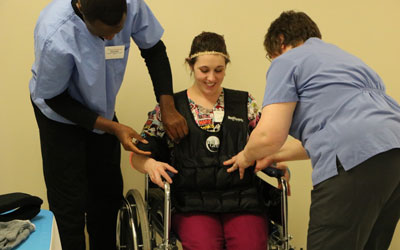
- To create an aging simulation experience, you could gather a series of things from your local big-box store, or even budget online sources, for ankle and wrist weights, ace bandages, back braces; weight training vests, along with interacting with canes and walkers. These things together can simulate mobility challenges like fatigue, loss of strength and restricted range of motion. Ankle weights can help simulate a shuffled gait as seen with some elderly people.
- Mobility challenges can be created by using walkers, canes, crutches, splints and a wheelchair.
- Hemiparesis/stroke simulations can be created with leg braces, Ace bandages, eye patches, slings and canes.
DIY Methods for Simulating Pregnancy
While there are several commercial pregnancy simulators available, here are a few do-it-yourself projects you can try:
- First, take a backpack and begin to fill it with a total of 25-30 pounds. The goal is to fill up the space in the backpack representing average weight gain by the third trimester. Then have the participant wear it backward so they can feel the difference in their center of gravity.
- Or you can simply take something you can fill with warm water like a hot water bottle or a beachball (partially filled up) and wrap it in a baby wrap or sling and wear it low on the abdomen.
- You could also use a medicine ball or smaller exercise ball that has some weight to it. Have students try to tie their shoes, pick things up off the floor, sit and stand up etc.
DIY Methods for Simulating Incontinence
This is a simulation experience that was recommended by a post-secondary Certified Nursing Assistant instructor. She said her students never again thought the same way about patient dignity and incontinence. This was especially important as her students were going to be working in nursing homes. She want them to recognize the importance of being attentive to patient needs as well as pride and dignity.
To simulate incontinence:
- Give each student an adult diaper
- Pour a small cup of water into it
- Have students wear it an entire class period
Learn more
If you’re looking for additional resources on wearable DIY simulations for health science classrooms, consider these:
- Watch Realityworks Product Manager Denise DuBois explore these ideas and others in her on-demand presentation, “Creating an Interactive Health Science Program: Wearable DIY Simulations You Can Use Tomorrow!”
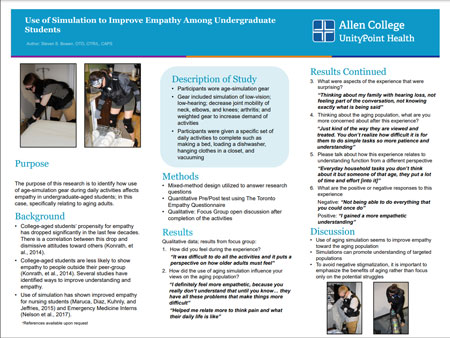
- This research study examines the effects age simulation suits had on undergraduate students
- Use these resources to learn how Realityworks’ geriatric training products can help your students develop the skills they need to provide quality care for aging patients