Our customers have been asking us: How are other teachers using RealCare Baby in a pandemic? This blog series features success stories of Family & Consumer Science (FCS) teachers who are finding creative ways to do exactly that, virtually and in the classroom. Keep reading to meet a Missouri FCS teacher who’s making it work.
Catch up! Read IL FCS teacher Melissa Priester’s story here. See SC FCS teacher Amy Waddell’s story here. Read MN FCS teacher Trude Sowada’s story here.
When the COVID-19 pandemic hit, Grain Valley High School FCS teacher Cheryl Beckman had just sent her RealCare Babies home with students. It was spring break in Missouri, so the timing was perfect. A 17-year veteran of the RealCare Baby Program, Beckman usually sends Babies home with students for a week. While her students were home with their Babies, however, Beckman learned they would not be returning for in-person instruction due to pandemic-related safety concerns.
Beckman immediately got to work.
“I reached out to the students individually, then went to their houses and picked up the Babies and supplies,” Beckman recalled. “They had had the Babies for about two weeks at that point. I asked them to put everything into trash bags, and when I pulled up, I texted them or their parents and said ‘I’m out front.’ They placed their Baby and supplies on the ground, and I loaded them into my truck.”
Beckman coordinated with her principal, who she’s worked with for 14 years. She got access to her classroom, where she stored her Babies and supplies until the 2020-2021 school year began.
“When we went virtual, of course my biggest concern was that my students had enough food at home,” said Beckman. “But when we learned students would be returning for in-person, socially distant learning that fall, we immediately started planning.”
A 7-Day Simulation Experience
“When I started this program, I didn’t want it to be just a gimmick,” said Beckman. “Yes, babies are cute and fun, but they’re also a tremendous amount of responsibility.”
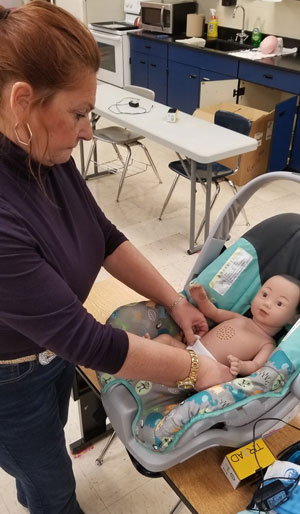
Beckman’s students typically pick up their Babies on a Tuesday after school, and they don’t return it until the following Monday. Beckman schedules each Baby so it is in “quiet mode” from 8am to 3pm on Wednesday, Thursday and Friday so other classes are not disturbed while students carry their Babies around all day, which is required.
“During the school week, students’ only responsibility during the day is to protect their Babies. On Friday, I give them a ‘Grandma Day’ so they can prepare for the weekend while I charge the simulators,” said Beckman.
Adjusting to a pandemic
When school resumed in the fall, Beckman’s two Child Development classes were blended for about two weeks, then entirely remote due to staffing issues. Beckman knew she had to find a way to conduct her Baby program, since so many of her students look forward to it.
“A lot of my students take the class simply because they want the infant simulator,” Beckman said. “So I went to my administrators and said, we need to figure out a way to make this work so they still get that experience.”
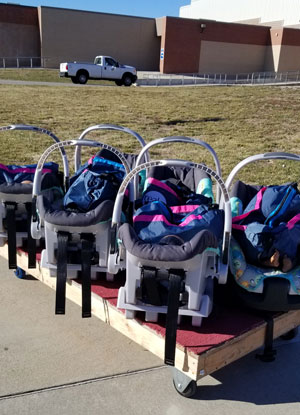
Beckman scheduled her students to come into her classroom one at a time every 15 minutes. She separated each Baby and supplies into spaced-apart, labeled piles. Then, she individually walked each student through the basics.
“Students came in, dressed their Baby and I made sure it was secure in the car seat,” said Beckman. “They learned everything else remotely.”
Beckman posted our RealCare Baby Participant Care video to her Google Classroom along with a screencast she created about caring for the Babies. She also posted reading materials, and conducted a live demonstration with a Baby in “demo mode” via videoconference.
“A lot of it is virtual, and I’m not typically a computer person – I still have chalkboards in my classroom,” said Beckman. “But I’m learning! And thankfully we can prepare a lot of this ahead of time.”
Grading new experiences
Beckman says the standards-based grading system her school district uses has been a blessing.
“We emphasize our students being able to show us in different ways how they are learning the material,” she said. “So if they demonstrate that they understand safety requirements of an infant, for instance, they’ll receive a passing grade. I did not really change my grades or my expectations of my students, but I am trying to be sensitive to what they are dealing with.”
Beckman uses a combination of RealCare Baby curriculum and reflection pieces to assess her students.
“They don’t currently have the opportunity to be in school and compare notes with one another, but they do get their little Snapchat groups going,” she said. “I know they get that natural bonding between young moms and dads.”
A team effort
Halfway through the school year, Beckman reports that “things have gone really well. As always, [Baby] is a big hit.”
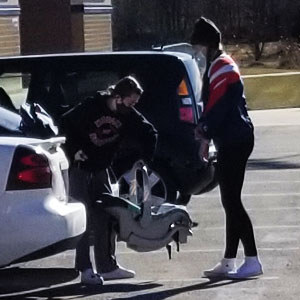
Beckman has spent more time in her classroom than usual to ensure her Babies and supplies are safely returned and prepped for the next students. She’s created a schedule that allows each Baby to be in her classroom for 24 hours before going home with the next student. Prior to that, students return Babies one by one. They remove clothing and wipe down everything with a sanitizing wipe. Beckman follows by laundering everything and wiping each item down again.
“On the days the Babies come in, I anticipate I’ll be here late to get all the laundry done so there’s no intermixing,” said Beckman. “It will take a few more minutes, yes. But you know what, this is the thing – we are grown-ups; our brains are mostly fully developed, and we struggle with some of the rules and regulations that are being put upon us. If I can help my kids get through this by putting in a couple of extra hours a day so they have something that’s somewhat normal, it’s a no-brainer.”
Beckman also credits her administrators with enabling her program to continue this year.
“I’d gotten to the point where we weren’t able to do it because people were so worried about germs. My administrators said, ‘we’ll figure it out,’” Beckman shared. “And I’m so glad.”
“We know that children learn best from play,” Beckman continued. “These students, being able to actually be awakened in the middle of the night, to have to fumble around in the dark to find a bottle, that’s reality. They can read that that’s what happens… but when they’re the one that wakes up in the middle of the night and stubs their toe as they fumble for a bottle, that’s hands-on learning at its best.”
Resources for learning more
Are you looking for more information on using RealCare Baby in a pandemic? Consider these resources:
- Catch up on this blog series:
- Case study: Engaging 21st Century Family & Consumer Sciences Students: The Impact of Infant Simulators
- Free guide: RealCare Baby Implementation Guide