“High school was really my first opportunity to have agriculture classes and then I realized plants were my thing,” said Katelynn Sibley, now one of the agriculture teachers who helps students discover similar passions. Sibley and Tracy Heinbuch, a fellow agriculture educator, teach ninth- through twelfth-grade students at Plymouth High School (PHS) in Plymouth, Wisconsin.
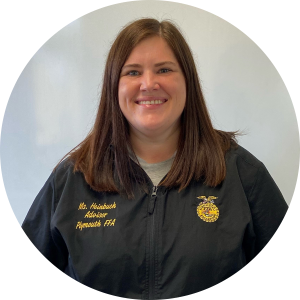
“We have a wide variety of students, from students that live in town and take care of their dogs to students that come from that traditional production agricultural background,” said Heinbuch, who has taught at PHS for 11 years. “Regardless of what class they take, our goal is to help them become good agricultural consumers.”
Tracy Heinbuch
Agriculture Teacher
Plymouth High School
With a variety of students, it can be difficult for agriculture teachers to keep everyone’s attention focused during class. One way Heinbuch and Sibley maintain student interest is through hands-on learning aids, like Realityworks’ Bovine Injection Simulator, Bovine Breeder™ artificial insemination simulator, and animal models.
“We learn best when we can touch things,” said Heinbuch. “Even when we do the injection simulator, there are some kids that are nervous like, ‘I’m not going to find the vein to do the IV draw or injection.’ First of all, remember this is not a real animal. This is why we do this, so you have that opportunity to palpate for the vein, to feel the pulse, to do those things and not be as scared.”
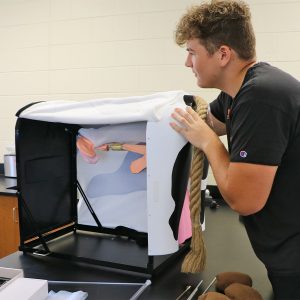
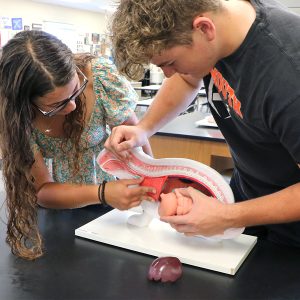
 Plymouth High School student Hollee Kaiser agrees with her agriculture teachers. “It takes the book knowledge you know and puts it in real-life situations,” Kaiser stated. “The AI breeder [helps] you learn about it. You look at diagrams, but you don’t know what it actually is like until you do it. Even looking at the uterus [models] that we have, you look at them on a piece of paper and you’re like, ‘Oh, OK, whatever.’ Then you’re like, ‘Oh that actually makes sense,’ since you see the 3D diagram.
These educational tools help students gain confidence in their skills and give them a break from typical lectures and computer work.
“You’re helping those students build that confidence and understand what they’re looking for, feeling for,” Heinbuch shared. “Sometimes them teaching each other is when they learn the most. It’s not listening to us, necessarily. It’s being able to do and move around and help each other.”
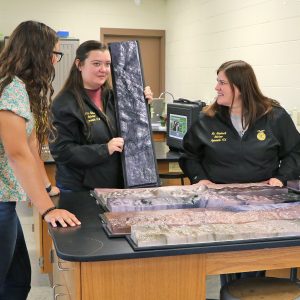
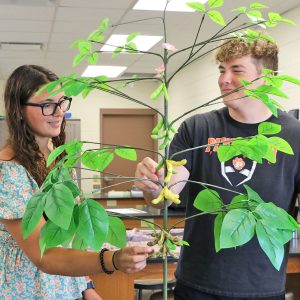
Visual models can encourage student excitement and exploration while giving them those light bulb moments agriculture teachers love to see. Another tool Heinbuch and Sibley use to encourage those moments is the Soil Monolith Kit, a set of 12 models depicting various soil types found in the United States. From Histosols to Inceptisols, students can compare the details and textures of each soil type represented on the models.
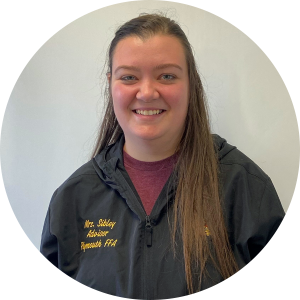
“I think it gets to those ‘ah-ha’ moments,” said Sibley, who you might recognize as the author of our Farm to Fork Lab Kit Curriculum. “This allows them to actually explore and kind of make their own connections. Some things are more exciting to learn than others. Typically, soils are not kids’ favorite thing to learn. When you can actually show them things that they can see in person… this helps kind of bridge that gap.”
Katelynn Sibley
Agriculture Teacher
Plymouth High School
Honing Skills Through Safe, Realistic Simulation
These simulators help students practice a variety of skills before performing them on live animals. This makes it safer for both the students and the animals once they test their skills on live animals. Simulators and models also give them a realistic way to learn these skills when agriculture teachers don’t have live animals available.
“We also don’t have the advantage of having live animals here,” Sibley stated. “There’s also the safety aspect of that too where the student isn’t going to get hurt, or they’re not going to hurt the animal either. Accidents happen, but it’s just easier to control with some of those models and things.”
Using these tools helps ensure students can easily think back to what they saw or practiced with the simulator and apply it to any real-life situations they encounter.
“Building confidence in our students helps them be more successful in the long run,” Heinbuch shared. “The more times they can practice in an IV or an injection or tubing on the simulator, the more confident, I’m hoping, they would be when that real-life scenario happens. Whether it’s on their farm, with their animal, in a garden… allowing them to be knowledgeable and build that confidence that they know that they have those skills and abilities will greatly help them in whatever they do in their future.”
Kaiser experienced this first-hand when administering shots to her horse after using the Bovine Injection Simulator.
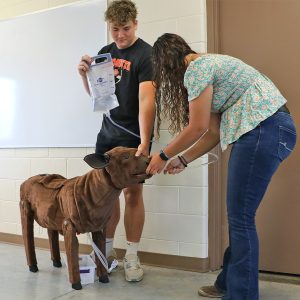 “We do our own shots on our horses. Doing that on the Bovine [Injection Simulator], it actually makes sense,” said Kaiser. “When we do IV injections, you can find it easier… Being able to just see it and feel it makes a big difference.”
The Calf Simulator is another teaching tool Heinbuch and Sibley use to get students excited about learning. This life-size simulator gives students hands-on practice addressing a variety of major calf issues, helping them understand the importance of caring for cows during their most vulnerable phase of life.
“We got our Calf [Simulator] at the end of the year, so then we got a lot of ‘Really? Why couldn’t we get this sooner? I’m done with the class now,’” explained Heinbuch. “I think that just proves that kids are excited to have the opportunities to try and work with those things as they are impactful in our day-to-day classes and conversations.”
These simulators even spark the interest of students who aren’t in agriculture classes.
“Even with kids that we have in our homeroom… they’ll come in, and they’ll be like ‘Oh my gosh, what is that? Why do you have a cow butt down here?’” stated Heinbuch, referencing the Bovine Breeder. “Sometimes that encourages them to take an ag class, and if it doesn’t do that, you at least made them more knowledgeable about some aspects of agriculture.”
Students and agriculture teachers alike enjoy using the simulators. These tools get both parties excited about teaching and learning.
“Students have their favorite tools and things we bring out,” said Sibley. “We, ourselves, have some of our own favorites that we get a little bit extra excited about. I think, as a teacher, that helps when you’re kind of dragging and you don’t always want to do school.”
Kaiser, who is interested in pursuing a career in veterinary medicine, enjoys vet science simulators. One of those tools is the Suture Kit. This kit helps create accuracy and proper technique through repeated suturing technique practice to develop key vet tech skills. It features realistic skin and various instruments, such as scissors, toothed forceps, and scalpels.
“My most favorite was the Bovine Injection,” said Kaiser. “You could actually see when you hit like the vein and everything. I also really like the Suture Kits that we have because you get to do all the different sutures on the pad.”
Measuring Success Through Assessments and Connections
Sibley and Heinbuch can tell these tools are working by the connections they see students making between the learning aids and the real world. For example, when students study the models in the Greenhouse Insects Kit, a kit featuring eight oversized insect models, and then point out the real versions of those bugs in the greenhouse later.
“We see them being successful in class,” stated Heinbuch. “The real thing is when they’re able to apply that outside of the classroom. Because, let’s be honest, we’re not teaching them just to be successful within these four walls. It’s life-long learning we want them to obtain.”
Heinbuch and Sibley also use simulators and models themselves to assess students’ skills and measure their learning success.
“It comes down to perfecting those skills,” explained Sibley. “I’ll do things where we identify the different soil monoliths. I put a number on each of them, and they do get kind of a quiz. They have to be able to write down which one actually was which number.”
 Heinbuch performs similar assessments in vet science classes when evaluating students’ clinical skills.
“With the Injection Simulator, it’s not just ‘Can you pull back on that injection?’” shared Heinbuch. “They have to talk us through those steps too. …Sometimes our assessments are not paper-pencil. Walk us through what you’re doing and show us that you’re capable of doing that.”
A variety of assessments are included in the curricula that accompanies Realityworks’ learning aids, and Sibley and Heinbuch select the activities and slide presentations that fit with their existing lesson plan.
“There’s always pieces within any of the products’ curriculums that can be helpful,” said Sibley. “Sometimes it’s those maps, those pictures, diagrams, and the PowerPoints that are very helpful to put up on the screen, especially when you’re giving that background information… The Bovine Breeder curriculum is laid out super nice in that there’s a notes outline.”
Sibley took the scenic route in becoming an agriculture teacher, studying soil and crop science, environmental horticulture, and agriculture business before pursuing a teaching career. With her background centered around plants, she found herself learning new information from the animal science curricula.
“I maybe learned a little bit from some of the curriculums,” stated Sibley. “Being a new teacher, in those areas where I’m not as strong as some the other areas, it was nice to have those things to reference. It kind of gave me confidence in those first couple years, especially when I was nervous and wanted to make sure I was giving those kids the right information.”
Finding New Activities and Tools
Heinbuch and Sibley get a lot of their ideas for classroom activities and tools from networking with other agriculture teachers, something they encourage other teachers to do. Through word of mouth and social media groups, they and other agriculture teachers share the products and companies they find work for them.
 “We, obviously, have used Realityworks a lot,” explained Heinbuch. “We know that the materials are solid and good and that, when we have questions about things, the customer service is phenomenal. So, those are the people and companies we share and reference and use as examples in various things. Obviously, we also have resources like our Ag Lab Discussion group on Facebook.”
Sibley encourages agriculture teachers to reach out to education companies and other teachers when they need help or have questions.
“Using Realityworks as an example, look online. Once you start kind of digging and looking, you’ll start to find those resources, like the free posters the free curriculum,” shared Sibley. “It’s hard as a new teacher, but the biggest thing is to ask and get people who use this stuff and use different curriculum to share that.”
Tools and resources like those mentioned above and shared with agriculture teachers online help Heinbuch and Sibley engage with and educate Plymouth High School students about a variety of agriculture topics.
“At the end of the day, we just want our students to be excited about what they’re learning in class,” said Heinbuch.
Learning tools used:
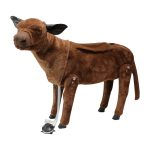
Calf Simulator
Give students hands-on opportunities to practice addressing a variety of major calf issues with our life-sized Calf Simulator. Help them to understand the importance of caring for cows during their most vulnerable phase of life.

Bovine Injection Simulator
The Bovine Injection Simulator is a one-of-a-kind education tool. Use it to teach proper cattle injection techniques (including IV administration plus jugular, intramuscular and subcutaneous injections), ear tagging and growth implant basics.

Bovine Breeder™ artificial insemination simulator
This simulator is a unique learning aid that teaches correct cervix manipulation, AI gun positioning and pregnancy palpation. It allows students to see inside the reproductive tract to identify reproductive system landmarks.
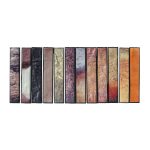
Soil Monolith Kit
From Gelisols to Entisols, the Soil Monolith Kit includes 12 monoliths of the soil types found in the United States. Students can compare the details and textures of each soil type represented on the monoliths.
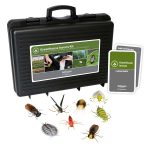
Greenhouse Insects Kit
The eight oversized models in this portable Greenhouse Insects Kit represent adult greenhouse insects in realistic, full-color detail. Use the models and accompanying curriculum (including flashcards) to help students identify larva and adult insects.
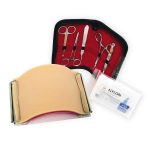
Suture Kit
The Suture Kit helps create accuracy and proper technique through repeated practice to develop key nursing and vet tech skills. Students are able to practice multiple and varying cuts as well as suturing techniques.
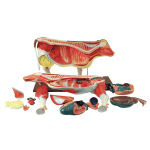
Animal Models
Bring animal anatomy lessons to life with our line of highly detailed animal models.