With over 3 million births in the US every year, it’s important to teach today’s students infant care skills. Whether they plan to be parents someday or work in childcare or healthcare, Realityworks’ infant simulators can help them learn important infant care topics, like substance abuse education, prenatal care, childcare skills, and more.
In a recent webinar, Denise Dubois, Realityworks’ Senior FCS Product Manager; Co-Chair, Alliance for Family and Consumer Science, introduced attendees to our most impactful babies. Read on to see what she had to say about how each of these unique simulators can be used to create engaging learning opportunities for your students.
Birth Disorders, Defects, and Conditions
1. Drug-Affected Baby
By emitting the cries and demonstrating the withdrawal tremors of a drug-affected infant, the Drug-Affected Baby shows the potential impacts of drug use while pregnant. Use this realistic infant simulator as a powerful demonstration in alcohol and substance abuse prevention programs, family and consumer sciences, child development and health classes, and more.
2. Fetal Alcohol Syndrome Baby
The Fetal Alcohol Syndrome Baby shows the potential physical effects of prenatal alcohol use. The brain models and animations that come with this infant model bring the concepts surrounding the cause of fetal alcohol syndrome (FAS) and its impact on infants to life. The infant features the small gestational size, flattened mid-face, and widely set eyes seen in infants with FAS.

3. Down Syndrome Baby
Use the Down Syndrome Baby to help increase awareness and understanding of infants born with Down syndrome. This simulator can help teach the 12 common physical attributes that an infant with Down syndrome may exhibit, such as a prominent forehead, the skinfold covering the inner corner of the eyes, and Brushfield spots.
4. Birth Defects Baby
Increase awareness and understanding of common birth defects, including spina bifida, cleft lip, anencephaly, and clubfoot with our Birth Defects Baby and curriculum, which addresses topics like risk factors, health challenges, and misconceptions. Having a model like this that provides a hands-on visual for students to pass around and examine can help make this difficult infant care topic a little bit easier to teach.
Get a sneak peek at Birth Defects Baby’s curriculum here.

Newborn Care
1. Preemie Baby
The Preemie Baby is a non-electronic manikin that simulates a preterm infant born at 30 weeks. Help students, caregivers, and parents-to-be understand the unique challenges and, sometimes complicated, medical problems often associated with preterm birth. The baby features the puffy eyes, small gestational size, and thin arms and legs commonly seen in preterm babies.
2. RealCare Baby
RealCare Baby has been around for 30 years and teaches realistic infant care skills. It comes with four different curricula and a variety of accessories. This simulator features motion detectors, real infant sounds, and clothing sensors. It tracks caregiver behavior via wireless communication and monitors feeding, time in a car seat, and whether the infant is dressed appropriately for the weather.
Get a sneak peek at RealCare Baby’s Basic Infant Care Curriculum here.

Child Care
1. Common Childhood Illnesses Baby
The Common Childhood Illnesses Baby offers realistic practice identifying and handling a series of infant health conditions, including pink eye; diaper rash; chickenpox; hand, foot, and mouth disease; diarrhea; middle ear infection; and fever. It includes a comprehensive curriculum that teaches students how to identify illnesses and care for infants in a variety of health-related scenarios.
Check out a sample of this baby’s curriculum here.

2. Child Care Experience Program
The Child Care Experience (CCE) Program creates a popup childcare center in your classroom. This simulation provides a great capstone project for childcare classes, allowing students to practice more advanced infant care skills. It’s meant to be used repeatedly throughout the semester. You can start with reviewing basic infant care skills, like feeding, burping, and changing diapers. Then, have students run through the full simulation with all the CCE Babies, clocking in via the included smart device just like a real childcare worker.
See how you can implement this program into your classroom here.
Child Safety and First Aid
1. Shaken Baby
Use the Shaken Baby simulator and curriculum to help students understand the effects only a few seconds of shaking can have on an infant’s brain and how to safely soothe a crying infant. After being shaken, this unique simulator’s transparent head illuminates to illustrate where brain damage has occurred. Then, use the included swaddling garment to practice soothing the simulator, which will stop crying when the swaddling garment is correctly applied.
Check out a sample of Shaken Baby’s curriculum here.

2. Choking Baby
This hands-on Choking Baby simulator teaches the correct technique and force needed to dislodge an object from an infant’s windpipe. It has a small ball that goes into the baby’s mouth, which students can dislodge through a series of back slaps and chest thrusts. This teaching tool can add hands-on learning to childcare worker, nurse, and babysitter training.
3. Infant CPR Manikin
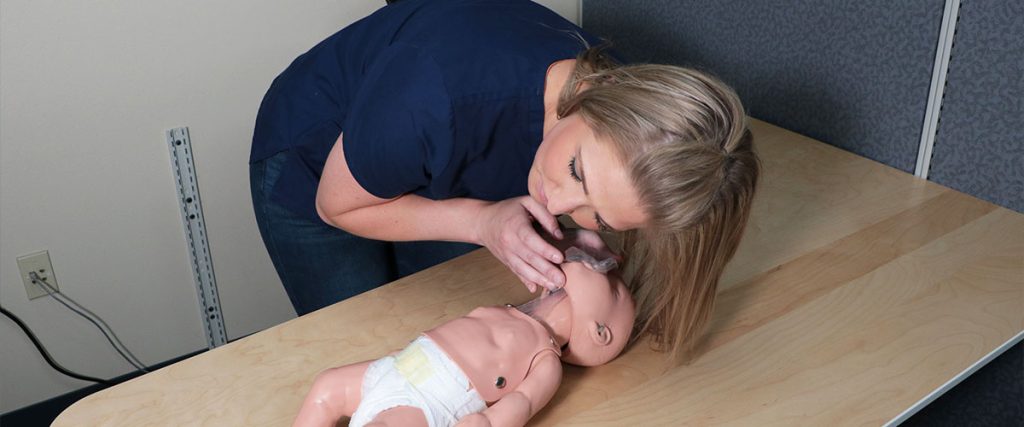
The Infant CPR Manikin and included curriculum gives users hands-on experience performing infant CPR. This is a critical infant care skill for childcare and healthcare workers. Use this lifelike, non-electronic simulator to practice proper infant CPR and the head tilt/chin lift required to open an infant’s airway. This manikin comes with curriculum and sanitary bags.
View a sample of this manikin’s curriculum here.
Additional Resources
- Watch the full webinar on-demand any time
- Explore free career and technical education posters and infographics to display in your classroom
- Check out our free career exploration curricula, each containing four to five lessons related to a variety of career pathways