 Looking to bring the benefits of aquaponics and hydroponics to your classroom? In a recent webinar, Jamey McIntosh, Realitworks Education Programs Manager, shared how hands-on, classroom-friendly hydroponics and aquaponics systems can help you introduce students to STEM concepts. Read on to see what he had to say about how these systems can benefit your classroom.
Educational Benefits of Aquaponics and Hydroponics
From career exploration and STEM to sustainability and farm-to-table concepts, aquaponics and hydroponics systems can be used to teach a variety of topics. Growing and experimenting with the plants themselves can increase students’ engagement, making the concepts more memorable. These systems can help students develop their critical thinking skills and science literacy and maybe even get them to eat more fruits and vegetables!
Types of Hydroponics Systems
Now that we understand the educational benefits of aquaponics and hydroponics, let’s look at some of the different types of hydroponics.
- Deep Water Culture: Plant roots are suspended in a nutrient solution and oxygen is released into the water to keep the roots from drowning.
- Ebb and Flow: In an ebb and flow, or flood and drain, system, a timed water pump regularly floods the plants with nutrient-rich water that includes a nutrient solution. Then, the water slowly drains back into the nutrient solution.
- Drip System: A water pump draws water from a nutrient solution and drips it continuously on the plants. The drain returns the water to the nutrient solution.
- Nutrient Film Technique: The plants are secured to a ramp and water is pumped onto the ramp from a nutrient solution. Water flows down the ramp and drains into the bath, continuously bathing the plants’ roots.
- Aeroponics: A water pump draws water out of a nutrient solution and sprays a mist directly onto the roots of the plant.
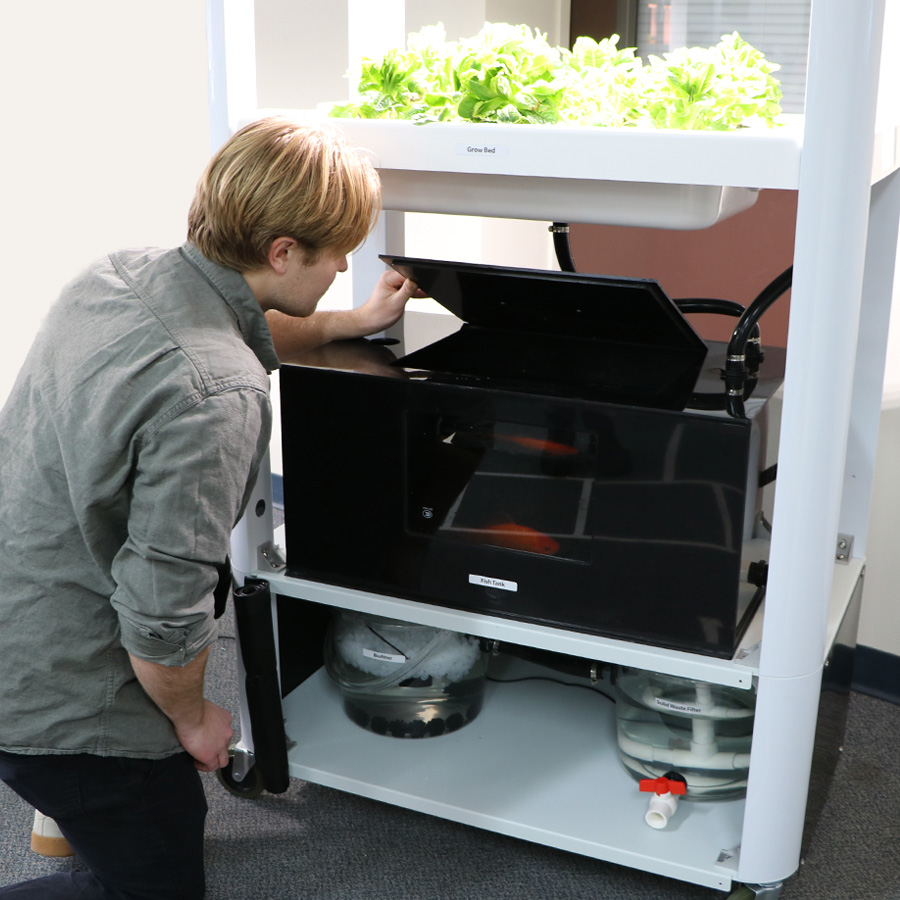
- Aquaponics: Nutrients in fish waste are converted from ammonia to nitrogen and provide nutrients for the plants. Plants filter the water to keep the fish healthy.
Benefits of Aquaponics and Hydroponics Systems
Saves Space
In many places, especially cities, there isn’t always enough space or soil available to grow plants in the ground. These systems allow people to grow gardens in limited spaces. Similarly, you might have limited space in your classroom. These systems allow students to grow plants at school without a designated gardening space outdoors or filling your classroom with potted plants.
Clean and Efficient
This type of growing is a clean and efficient way to grow vegetables and other plants. With these systems, you can grow plants year-round, no matter the season. These plants do not need pesticides, which makes the crop safer to eat and is better for the environment.
Solves Food Shortages and Growing Issues
This type of growing can help solve food shortages, especially in areas where drought and famine and issues. Where weather conditions are unfavorable for large scale crop production, these systems can help overcome these weather variables.
Increases Growth Rates
Water and nutrients are continually available to the plant roots, allowing plants to grow at the fastest rate possible. This type of growing can reduce the time between planting and harvest by controlling the growing variables. Biosecurity and environmental factors can help to grow food more readily. In the classroom, this means you can grow a variety of plants and experiment with the growing variables multiple times throughout a single semester.
Learn and Experiment with New Ways to Grow Plants
Test and experiment with different growing variables, such as growing different plants and adjusting the nutrient levels. Challenge ideas and growing methodology to find better ways to grow food.

Getting Your Program Started
Now that we know the benefits of aquaponics and hydroponics systems, let’s take a look at what you need to start your own program. To begin, you’ll need seeds, nutrients, rock wool, a growing tray, lights, fans, and water pumps. The lights mimic sunlight, including the red-and-blue light spectrum, to help plants grow. The fans help strengthen the plants and reduce injury and disease. The water pumps circulate the water, allowing vital nutrients to reach the plant roots.
Lettuce is a great starting plant for hydroponics and aquaponics beginners; the germination period is 4-10 days, and it takes 35-65 days to mature. Another good starter plant is kale, which takes 3-10 days to germination and 55-80 to mature. For more advanced growing, cucumbers are a great option with a germination period of 6-10 days; they take 55-65 days to mature.

Classroom-Ready Educational Systems
Here are some educational systems designed to bring the benefits of aquaponics and hydroponics to your classroom.
Plant Lab Educational Hydroponics System
Experiment with varying quantities of greens while addressing key plant science, STEM, and sustainability efforts with he Plant Lab Educational Hydroponics System. Its three vertical shelves connect to individual water sources, enabling experimentation with plants, water levels, and nutrients on each level. The system includes 33 plants sites, LED grow lights, fans, a water pump, a two-gallon water tank, reusable grow cups, and a plant starter kit.

Plant Producer Educational Hydroponics System
Grow production-level quantities of greens while addressing career exploration, STEM, and farm-to-table concepts with the Plant Producer Educational Hydroponics System. Its three vertical shelves connect to a single water source, enabling equal nutrient allotment and concentrated growth on each level. See how Brenda Collins, an agriculture educator in North Carolina, uses this system in the video below.
Plant Mini Educational Hydroponics System Class Pack
This Plant Mini Educational Hydroponics System Class Pack enables you to try three different growing options: ebb and flow, deep water culture, and microgreens. Having five desktop-size systems allows individuals and small groups to grow a variety of plants. Incorporate STEM concepts into your curriculum and offer hands-on experimentation with these convenient systems.

Educational Aquaponics System
This standalone Educational Aquaponics System can be used to experiment with both ebb and flow and deep water culture grow methods. It features 14 plant sites and a 33-gallon freshwater fish tank with room for 5-10 fish. It comes with a fully functioning, out-of-the-box biofilter and sustainable nutrient system. See an overview of the system in the video below.

Additional Resources
Looking for more classroom aquaponics and hydroponics resources?
- Watch the full, on-demand webinar
- See how you can implement these systems in your classroom here
- Book a consultation with your account manager to see how you can start or refresh your program with these interactive tools