How did your CTE programs evolve? How are you measuring quality? For CTE programs to be successful, leaders must ask themselves not just whether their programs are producing adequate outcomes, but also whether CTE systems are targeting the students who need them the most.
Recently, Realityworks Education Development Manager Diane Ross, M. Ed., presented a free webinar on why it’s essential that CTE program directors expect more from their programs. She shared tips on how program directors can raise the bar, like utilizing updated, state-of-the-art technology so students can learn how to analyze data.
Click below to watch the complete presentation, “The Driving Force Behind Innovation: Skills-Based CTE,” on-demand anytime. Or keep reading for presentation highlights.
Opportunities to raise the bar
Although CTE program leaders have many opportunities to raise the bar within their programs, Diane focused on five of the 12 components that define a highly effective CTE program:
- Facilities, equipment, technology and material
- Engaging instruction
- Standards-aligned and integrated curriculum
- Access and equity; and student career development
Today’s students need engaging instruction that is aligned to the curriculum in order for them to practice the skills they will encounter in their careers.
The Association for Career & Technical Education defines quality as:
The measure of how successfully each program is able to teach all enrolled students workplace standards, competencies and skills necessary for them to practice careers within their chosen field after graduation, while at the same time supporting a high level of student performance in core academic areas and skills. Mechanisms are in place to ensure high-quality programs align with current workplace standards, practices and competencies.
In the jobs of the future, students will be using technology to analyze data. They’re also going to be analyzing that data and making decisions about next steps with that data. Today’s CTE programs need to be teaching skills tied to analyzing data. There is an opportunity here to raise the bar.
How to raise the bar
In Health Science Programs
Health science students will need to analyze data from wearables that patients are going to have. Telehealth is growing immensely; today’s students will need to read, interpret and analyze data.
When we started creating our health science programs here at Realityworks, we looked to industry standards and what health care professionals were seeking in educational training programs like nursing. They told us they were looking for the application of appropriate knowledge; their students needed to learn skills and behaviors within clinical settings.

This is what a skills lab might look like that is fitted with simulations that allow students to experience clinical scenarios. Using tools like our ECG Simulator and Blood Pressure Simulator allow students to practice, then be assessed, on a variety of scenarios within a classroom. They allow students to understand “the why,” analyze the data and fully understand the skills involved. Building a skills lab that is designed for students to learn and understand basic to more advanced skills will help prepare them for true clinical experiences.
Learn more. Our health science pathway packages offer training tools that address the most commonly used and specified skills that are necessary to work towards industry certifications. Learn more by clicking here.
In Trade Skills Programs
This is what a modern welding program might look like – an engaging setting that allows for concept retention and career exploration, and that establishes foundational learning.
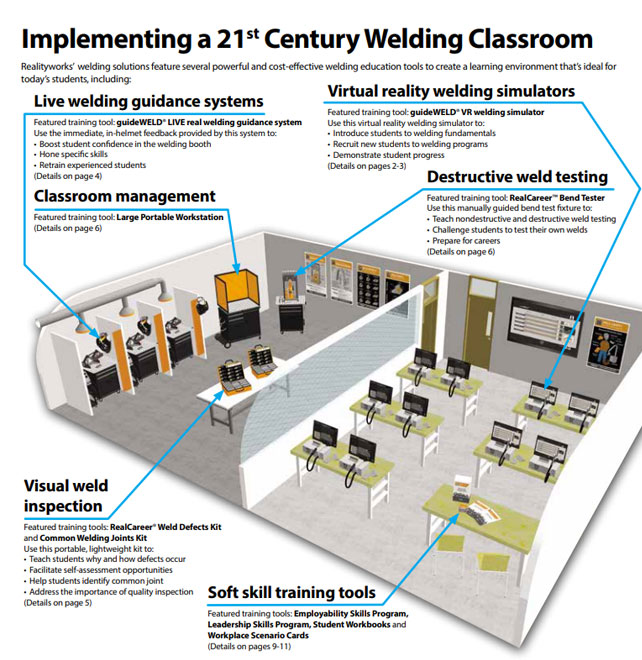
Using tools like our guideWELD® VR welding simulator, students can learn and practice proper procedures and form before they enter the welding booth. Adding our guideWELD® LIVE to welding booths is like having an instructor in every booth – instead of students running back and forth to the teacher asking questions, they are getting instant feedback immediately.
Learn more. Our trade skills pathway packages offer training tools that address the most commonly used and specified skills that are necessary to work towards industry certifications. Learn more by clicking here.
In Agriculture Programs
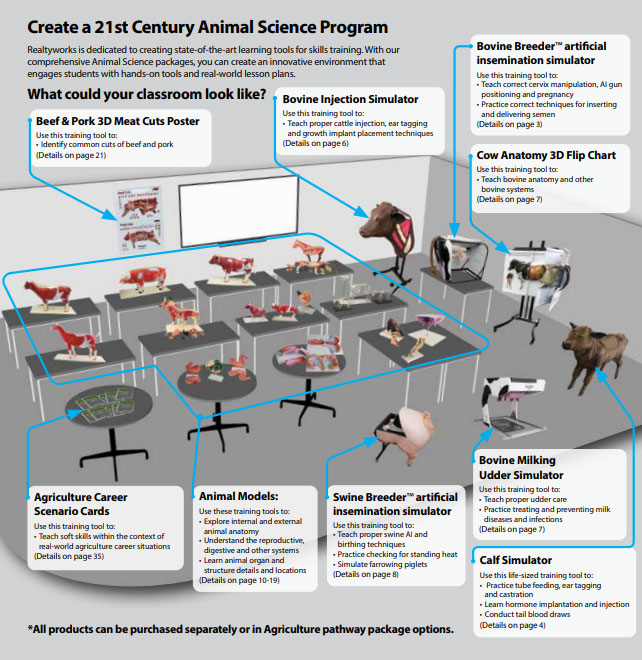
This is a look at what a 21st Century ag classroom might look like in your school. We work to prepare students for what they’ll see in the real world. Instead of bins of animal body parts soaking in formaldehyde, students can practice and work with animals in their true form. They can practice giving cows injections. They can practice artificial insemination on simulators. Many times, being on a farm is difficult – when the farmer has time, you’re doing something else. This gives you the opportunity to visit these things as your students need to learn.
A great example of this is one of our newest learning aids, the Bovine Birthing and Ultrasound Simulator. This tool allows the students to care for a pregnant cow by conducting bovine ultrasound and birthing a calf. The simulator mimics the weight and movement of a newborn calf, while the ultrasound simulator simulates more than 20 common situations, allowing the student to diagnose common issues. This simulation not only teaches students how a calf is born and the complications that can arise, but it exposes them to modern technology that’s becoming more commonplace on farms, in vet tech centers and in universities.
Learn more. Our agriculture pathway packages offer training tools that address the most commonly used and specified skills that are necessary to work towards industry certifications. Learn more by clicking here.
In Family & Consumer Sciences (FCS) Programs
This is a look at what a 21st Century early childhood education classroom might look like in your school.

We’ve come a long way since the creation of our flagship product, RealCare Baby®, which has taught millions of students how to care for an infant and has led to child care careers across the world. Using the tools pictured here, your students can not only practice important child care career skills but develop soft skills like critical thinking, problem-solving, empathy and sensitivity.
Learn more. Our FCS pathway packages offer training tools that address the most commonly used and specified skills that are necessary to work towards industry certifications. Learn more by clicking here.
What will the future look like for your students?
To prepare students for futures that will be filled with data, analytics and new technologies, we need to give them to the most modern technologies and experiences that we can. We can do this by:
- Offering engaging instruction that is skill-based and hands-on and that prepares students for analyzing data
- Utilize standards-aligned curriculum with learning resources aligned to industry certification
- Ensure access and equity, so all students have access to new and emerging technologies and techniques
- Focus on student-centered development that prepares students for the next steps
Our goal is to show students what to expect before they encounter the real thing. It allows them to develop a higher understanding before the real-world situations they will be entering in careers. We can expect more.
Contact us for an in-depth consultation so you can better evaluate your programs and create an enhanced learning environment for your students!
Resources for learning more
-
- Watch the complete presentation, “The Driving Force Behind Innovation: Skills-Based CTE,” on-demand anytime below:
- See the standard (and custom!) pathway packages we offer here
- Contact us to learn how you can ensure your program – and your students – are ready for the future