 As the aging population grows, the need for nurses and caregivers educated in geriatric patient care increases. In a recent webinar, we shared several suggestions for engaging today’s students and helping them develop empathy as well as sensitivity toward geriatric patients. Read on to learn how to pique student interest and what tools you can use to create realistic geriatric simulations when patient interaction isn’t an option.
Who Are You Teaching?

So, who are today’s students?
Today’s students are digital natives!
This is a term often used to describe today’s students, most of whom were born after 1997 and are therefore members of the post-millennial “Generation Z.” The oldest are in their mid-twenties and the youngest are about 10. They are considered digital natives because they grew up with technology, and have never known a world without smartphones.
Whereas Millennials were considered “digital pioneers,” who bore witness to the explosion of technology and social media, Gen Z was born into a world where information was immediately accessible and social media was the norm.
About 72 million Americans belong to Generation Z, according to the most recent Census Bureau data. While over a third of them either hold jobs or are self-employed, 51% are still students.
And the needs of all those Generation Z students are changing the way you teach.
For instance, the standard classroom model where an educator stands in front of the class and lectures just doesn’t work.
Gen Z students seem to be experts in technology to the point they need minimal management. However, on the other hand, their generation is characterized by a lack of concentration, which is deeply affected by smartphones and social media trends.
So, how do you teach students who don’t engage with standard slide presentations and textbooks? You mix things up. You can still use your lecture slides and required reading but add in activities, group work, and quizzes to keep students on their toes.
Giving them opportunities for project-based learning like internships and other hands-on experience can also increase their interest and retention.
Strategies for Teaching Sensitivity in Geriatrics
1. Find Out What Works
One of the best methods for teaching students is asking them how they learn and adapting your coursework to their learning styles. Distributing a questionnaire at the beginning of a course with questions regarding learning methods can give you a great idea of what works best for each individual class. Encourage students to be honest when filling out the questions so you can best align your geriatric care coursework to their needs.
Want to get started right away? Check out the links below to find some free, ready-to-use questionnaires you can send your students.
2. Warm Up With an Activity
Start with an icebreaker activity to introduce students to the concept of empathy. You could try having students interview each other and introduce themselves to the class, encouraging teamwork while getting students familiar with each other.
Another activity idea is making an empathy ball with questions related to geriatric patient care and empathy such as “How do you cope when you’re feeling frustrated in front of others?” or “How can body language express how you feel?”
A third option is asking your students to describe the last time they were empathetic to help them see how small actions can make a big impact.
3. Add Relevancy With Real-World Examples
The more relevant your lessons are, the more engaged the students will be as they connect what they’re learning to their future careers. For in-person classes, you can have students stand up and share a soft skill they use in their job, sports team, or extracurricular group as well as a time they felt that skill made a difference. For online classes, have students share their experiences in a video call or through a slide presentation. Encourage students to think about how these are the skills needed to work with the older adults.
4. Bring In Subject Matter Experts
Inviting subject matter experts to your class demonstrates the relevancy of what students are learning and enables real-world connections while promoting engaging discussions. It’s best to have students prepare by coming up with a list of questions to ask the guest beforehand. Making time for reflection after the guest leaves can be helpful as well.
Some great subject matter experts for geriatrics courses include local nursing home directors, CNAs, dieticians, or anyone else that works with geriatric patients every day. Most industry representatives will be happy to help so don’t be afraid to ask!
 5. Incorporate Experiential Learning Tools for Geriatrics
Hands-on learning aids are great tools for creating an engaging classroom atmosphere that promotes exploration in geriatric careers and helps your students develop valuable job skills. Research shows that interactive, hands-on learning aids are incredibly effective, especially wearables and simulators. In fact, a study on the effectiveness of age simulation found that 83% of participants in the simulation were able to empathize with life in old age “very well” and 95% had a better understanding of the physical conditions of aging.
These tools are extra helpful when in-person interactions with real patients isn’t possible. This is where Realityworks can help!
Tried-and-True Tools for Teaching Geriatric Care
The RealCare™ Geriatric Simulator is a great wearable learning aid that allows users to experience geriatric problems such as limited range of motion, reduced mobility, stooped posture, and joint stiffness as well as visual impairments like cataracts and glaucoma.
This simulator comes with curriculum, featuring nine lessons on topics ranging from geriatrics and gerontology career exploration to hearing loss and cognitive changes with aging.
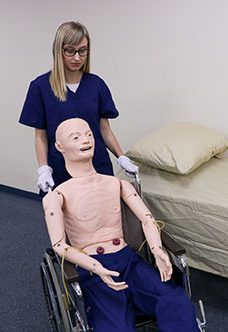
We also offer a Geriatric Medication Management Simulation Kit that helps students develop empathy for the challenges of geriatric patients who have multiple medications to manage. Our Geriatric Nursing Manikin is another helpful tool for fostering geriatric sensitivity and practicing basic nursing functions involved in geriatric patient care. The Geriatric Sensory Impairment Kit can also develop empathy and understanding with simulators for hearing impairment, arthritis, and tremors.
All these tools come with comprehensive lesson plans, student activities, slide presentations, assessments, and program completion certificates.
6. Create a Geriatric Sensitivity Training Workshop
Set up several stations around the classroom where students can experience different aspects of aging that geriatric patients experience. You can use the Realityworks tools mentioned above or create your own! One station can have the full geriatric experience with our RealCare Geriatric Simulator, another could focus exclusively on visual impairments, etc. You can customize the workshop in any way you want to meet the learning objectives of your class.
Learn More
Looking for additional information on geriatrics? Consider these resources:
- Check out our geriatric tool implementation page for a free guide on teaching empathy toward older adults, a free infographic on geriatric sensitivity, a free empathy self-assessment, and more
- Read our blog posts, Simple Steps to a Successful Geriatric Simulation, 3 Ways to Use Geriatric Simulators in Your Classroom, or 3 Results of Using Geriatric Simulation Scenarios with Undergrad Students
- Watch our complete webinar, “Helping Future Healthcare Professionals Develop Geriatric Sensitivity” anytime: