Hands-on practice is essential for healthcare students (even in today’s educational environment). Here are four health science training tools that will grab your students’ attention, add realism to practice scenarios and help them master key skills before encountering real patients. In fact, all of these health science training tools have earned national recognition for their impact on classrooms and sim labs.
What makes these training tools so remarkable? Find out:
Adult Nursing Manikin (2020 EdTech Awards Cool Tool Finalist)
A multitasking extraordinaire, our Adult Nursing Manikin can be used to practice almost two dozen basic care procedures. Use it to review proper techniques for patient transfer and handling, range of motion exercises, ear and eye care, hair and face washing… it even includes a feedback device that provides directed, specific, real-time coaching feedback on the rate and depth of chest compressions, which meets 2019 AHA CPR guidelines. We’ve also included our unique Multipurpose Venous Training Arm and FAST-fluid™ management system, so it’s easy to prime the veins; practice basic intravenous insertion, intramuscular injection and venipuncture procedures; then clean up afterward.
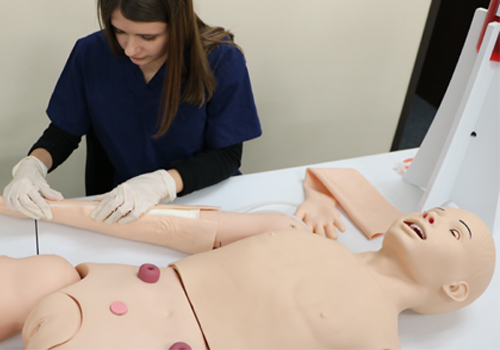
Give your students one-on-one and group time with this manikin so they can so they can practice CNA tasks like bed bathing and ambulation, and exchange the included genitalia to practice peri care and catheterization on both males and females.
Bonus: Our Adult Nursing Manikin includes lesson plans and activities that emphasize IV insertion, bolus medication administration and phlebotomy basics. Access these lesson plans even if you don’t own our Adult Nursing Manikin by clicking here.
ECG Simulator (2020 Edison Awards® Winner)
Our ECG Simulator combines hardware, software and curriculum to help students learn how to successfully conduct a 3-, 4-, 5- and 12-lead ECG. Start by giving students time to palpate the simulator and feel for the rib cage, collarbone and other physical landmarks. The ECG simulator may be used as a standalone lead placement trainer, but it also works in tandem with our proprietary software on recognizing common ECG rhythm patterns digitally and in print. The software provides practice scenarios and feedback on correct and incorrect lead placement, which students can use to make immediate corrections to their practice scenarios.
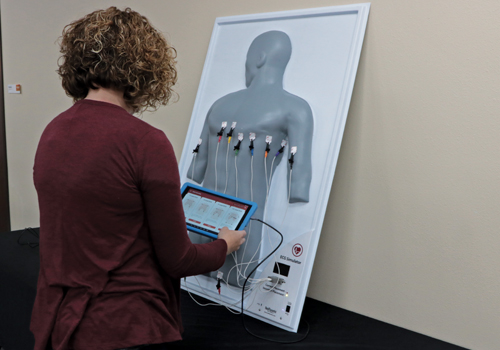
Bonus: Our ECG Simulator curriculum offers a great starting point for educators to teach students about placement of ECG leads and methods for mitigating commonly read errors. Access these lesson plans even if you don’t own our ECG Simulator by clicking here.
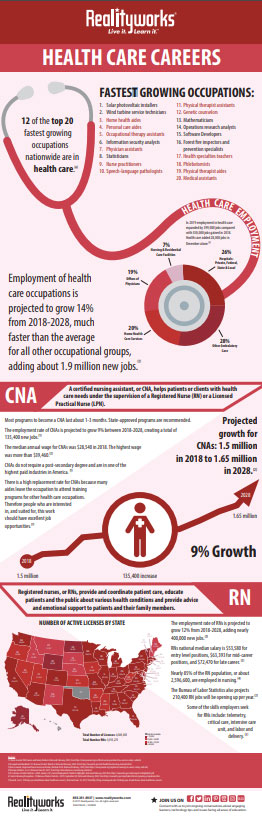
Could you use an infographic about in-demand health care careers for your classroom or lab? We can help! Download our free health science careers infographic by clicking below:
RealCare™ Geriatric Simulator (2016 Caregiver Friendly Award Winner)
When it comes to helping students develop empathy and sensitivity toward the elderly – essential skills for anyone who plans to work with the elderly – our Geriatric Simulator will make an impact. The Geriatric Simulator is a sensitivity suit that enables users to personally experience age-related physical changes. Combined with comprehensive curriculum, it gives the wearer hands-on experience with the many real-life conditions that geriatric patients deal with on a daily basis.

Instructors use this sensitivity suit in small and large groups as well as in one-on-one practice scenarios to give students young and old aging awareness training.
Bonus: Our Geriatric Simulator curriculum is designed for a multitude of programs, including Health Occupations pathways, CNA training and Family and Consumer Sciences pathways, including Human Development and Interpersonal Relationships courses. It includes geriatrics and gerontology career exploration, visual impairment, declining mobility due to aging, the impact of aging on bones and joints, hearing loss and more. Access these lesson plans even if you don’t own this simulator by clicking here.
Blood Pressure Simulator (2019 EdTech Awards Cool Tool Finalist)
Realistic practice is key to preparing healthcare students for successful encounters with real patients. With our wearable Blood Pressure Simulator, your students can get experience taking true-to-life blood pressure whether they’re working with other students, manikins or standardized patients. This simulator can generate both pre-programmed and randomized practice scenarios, giving students exposure to the variety of blood pressure readings they’ll encounter in real life – without the discomfort of an inflated cuff.

Bonus: Our Blood Pressure Simulator includes lesson plans and activities that focus on the measurement of blood pressure and the meaning of the results according to the American Heart Association. Access these lesson plans even if you don’t own this simulator by clicking here.
More Health Science Training Resources
Find more resources on teaching essential health science topics below:
On-demand webinars:
-
- The Art of Scenarios: Using Real World Scenarios to Teach Nursing and Soft Skills:
- Effective Teaching Strategies for EMS Instructors
- Developing Geriatric Sensitivity in Your Generation Z Students
- 10 FREE Resources for Teaching Health Science Concepts Online
Access the curriculum and activities that accompany our health science learning aids here.
Free guides: Implementing Geriatric and CAN Training Tools into your program
Watch a brief walk-through of our award-winning health science products here.
This is awesome! Using simulations like these in the classrooms offers invaluable benefits. These realistic scenarios provide a safe and controlled environment for students to apply theoretical knowledge in a hands-on setting. Students need more ways to develop for the 21st century and these practices foster experiential learning. In most high school settings, students will not be able to experience working with real patients or in a medical setting due to liability. Having students interact with manikins that mimic human responses and conditions, students gain practical skills that promote critical thinking, communication, collaboration, and creativity. Also, this instills global awareness as well. Students are engaged in real clinical settings, ensuring they enter the field well-prepared and equipped to deliver quality care.
Thanks for your feedback! We’re delighted to see this particular post resonated so much with you 🙂